


The Organization for Security and Cooperation in Europe (OSCE) published a report on the deportation and forced relocation of Ukrainian children by the Russian Federation. The document states that the Russian Federation has violated a number of international norms, including the UN Convention on the Rights of the Child.
"The deportation of Ukrainian children carried out by the Russian authorities may contain elements of a crime against humanity. There have been numerous and repeated violations of children's rights: to identity, to family, to education, to access to information, to rest, to leisure and participation in cultural life and art, as well as the rights to opinion, conscience and religion, to health I, for freedom and security," the OSCE states.
The organization built its document, taking into account data from both the Ukrainian and Russian sides. And he provides this information in a 90-page report, giving an assessment of the actions of the Russian Federation.
The OSCE emphasizes that the removal of children can be considered a war crime and reports on the following:
About the most common scenarios of displacement of children;
About coercion and threats to parents;
About violent methods of deportation;
About adoption in the Russian Federation and changing the data of children;
About moving children across the Russian Federation and concealing information about them.
How many children did Russia deport or forcibly relocate from Ukraine?
Currently, there is no exact number of exactly how many Ukrainian children were deported to Russia or moved to territories controlled by it (for example, to the occupied Crimea). Moscow claims that during the year of the full-scale invasion of the Russian Federation, it accepted 5.3 million people from Ukraine, including 738,000 children. Russian authorities do not provide more detailed statistics. It is impossible to verify this information.
Dmytro Lubinets, the Verkhovna Rada Commissioner for Human Rights, claims that the figure of 700,000 children is exaggerated. The ombudsman assumes that in total Russia illegally removed about 150,000 children from Ukraine. His colleague, Darya Gerasimchuk, Commissioner of the Verkhovna Rada for Children's Rights, calls the figure "several hundred thousand children, i.e. somewhere around 200-300 thousand."
Ukraine is trying to identify children illegally deported by Russia. So far, it has been possible to establish the names of 19,000 of them - the list with their names was recently handed over to the International Committee of the Red Cross. They have the authority to visit them and find out about the conditions of keeping children. As for the number of children who were returned, as of the end of April, there were only 361 of them.
The report also generally describes the situation with children in Ukraine.
Since February 24, 2022, more than half of the child population of Ukraine has been relocated within the state or abroad. According to 2020 data, more than 7.5 million children lived in the country. More than 105,000 of them were "status" and lived in orphanages or other institutions.
How do children get to Russia?
The OSCE report names three main scenarios of how Ukrainian children are taken to occupied or Russian territories. The first is the so-called "security evacuation" deep into Russian-controlled areas, away from the war zone. Referring to this reason, before leaving the right bank of the Kherson region, the Russian military took 80 children from the Oleshki boarding school to the Crimea and the Krasnodar region. Similar evacuations were also carried out by the Russian military in other captured regions of Ukraine.
The second scenario is the transfer of Ukrainian children for adoption or custody by Russian families. It is noted that the Russian authorities have been working on this since 2014 - after the occupation of Crimea, they launched the "Train of Hope" program ("Train of Hope"). According to it, anyone willing from any part of the country could adopt a child from Crimea, as they received Russian citizenship.
At the end of September 2022, Russian President Vladimir Putin signed a decree on the "accession" of the partially occupied Zaporizhzhya, Kherson, Donetsk, and occupied Luhansk regions of Ukraine to the Russian Federation. After that, children from the newly occupied regions also began to be enrolled as citizens of the Russian Federation and adopted.
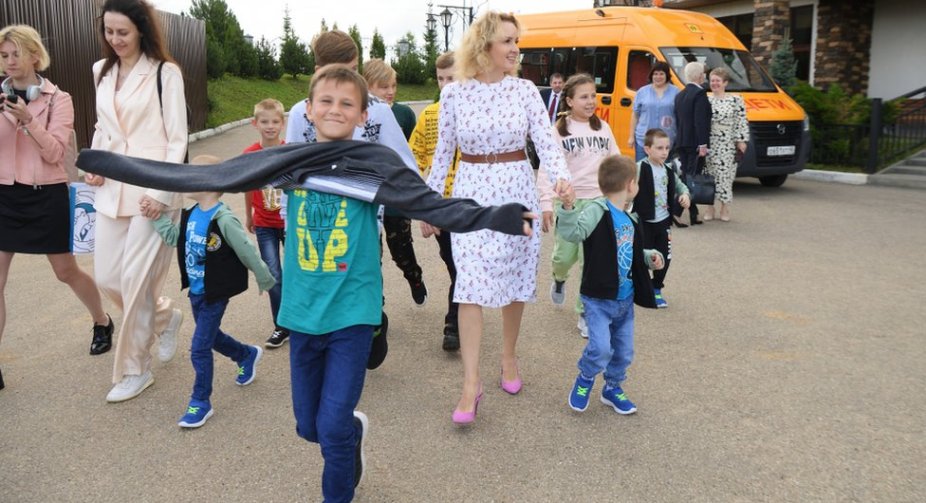
According to the OSCE, the most numerous cases are when children are sent to the Crimean camp or to the territory of the Russian Federation, allegedly temporarily for "rehabilitation". The report notes that it was difficult for the children's parents to refuse such offers for several reasons - the difficult conditions of being in the occupation and pressure from the Russian military. Later, the children were never returned to their parents, citing the dangerous situation in their native region.
"There are reports of children being moved between different camps without the consent of their parents or legal guardians. For example, in a summer camp in the Krasnodar region of the Russian Federation, about 200 children stayed after the summer and were enrolled in a local school," the OSCE notes.
Currently, we know about 43 institutions where Russians keep children from captured Ukrainian territories. At least six of them are in Crimea, these are the camps "Artek", "Luchisty", "Laspy", "Druzhba", the camp in Pishchany and psychiatric hospital No. 5.
Can the deportation of Ukrainian children be called voluntary?
The OSCE does not consider the cases of displacement of Ukrainian children - in particular, those who ended up without the care of their relatives - to be voluntary.
"The term 'coercive' is not limited to physical force, but may include the threat of force or coercion, such as fear of violence, coercion, detention, psychological oppression, or abuse of power," the organization notes.
Russia says it captured a teenager from Mariupol while trying to return to Ukraine. What is known about the child?
The authors of the report emphasize that some of the children who were in boarding schools at the time of Russia's invasion of Ukraine had parents or legal guardians. And, accordingly, the voluntary transfer of a child is impossible, if authorized adults did not consent to it. In addition, the OSCE is also aware of cases when the directors of institutions did not agree to the transfer of children - but this did not stop the Russian occupation authorities in any way.
"According to Ukrainian reports, at least two thousand children from boarding schools were taken to Russia, despite the fact that they have living relatives and were in these institutions only to receive medical care," the report says.
Likewise, those cases of displacement, when parents from temporarily occupied territories sent their children to health camps for several weeks, cannot be called voluntary. After all, as the OSCE assures, the Russian side uses the vulnerable position of parents, their desire to protect their children from shelling and the difficulties of life in the occupied territory, misleading them about the nature and duration of the so-called "vacation".
"Parents who did not want to send their children to the camps faced various types of threats - they say that their refusal will be interpreted as child neglect and may lead to a review of their parental rights," the report states.
How are Ukrainians separated from their children during filtering?
As for children separated from their parents, for example, at filtration points, these are coercive situations imposed by the occupation authorities, and, accordingly, "the question of consent does not arise," the OSCE says. It is not known for sure how many Ukrainians passed through the filtering, and the OSCE calls these cases massive.
The organization emphasizes that, according to international humanitarian law, detained families should be together. And even if there are grounds for their separation (state of health, execution of punishments, etc.), it should be temporary, and parents and children should be able to communicate. However, according to the OSCE, the Russian side did not provide it in any way. Even after the parents were released from filtering, the occupation authorities did not provide any information about the whereabouts of their children and did not help in any way to reunite the families. Sometimes the children themselves had to find ways to contact their parents.
As an example, OSCE experts cite the story of Yevhen Mezhevoy, a single father of many children from Mariupol. During the filtering process, Russian troops separated Yevgeny from his three children, and 45 days later they released him - without any information about them. The older son was able to contact the father to say he had five days to pick them up, or the children would be placed in foster care or adopted. Mezhevoi himself collected all the documents to prove paternity and traveled to Moscow at his own expense to pick up the children.
How do Russians adopt Ukrainian children?
In May 2022, Russia simplified the procedure for obtaining Russian citizenship for children from Ukraine. According to the decree of the President of the Russian Federation, guardians of children or heads of institutions where they are staying can independently submit applications for obtaining Russian citizenship for minor Ukrainians. Children's wishes are not taken into account.
OSCE sources in Russia note that the Russians themselves are "actively interested" in placing children from Ukraine in families. According to the organization, Russian families who want to adopt a child from Ukraine must take special patriotic courses. There are also "financial incentives" for them at the expense of local and regional budgets.
Adoption of a child who ended up in Russia without the care of relatives is considered a more priority option. Such children can change their names, surnames, as well as the dates and places of birth of the child - this makes it much more difficult to find them to return home. Adoption itself is not financed in any way, the OSCE notes - however, in some regions, adoptive parents are paid 300,000 rubles in one-time assistance.
How does Ukraine return deported children?
The OSCE report cites the statements of parents who returned their children from deportation. They noted that they faced "significant logistical difficulties." Currently, there is no officially approved mechanism for returning Ukrainian children home. This is only possible thanks to "private individuals" with the help of the Ukrainian Ministry of Reintegration of the Temporarily Occupied Territories, volunteers and non-governmental organizations - and probably with the help of "some Russian government officials operating through secret channels."
"Taught to love Russia." What happened to the children who were held in Crimea and the Russian Federation?
As for Russia's actions, OSCE experts did not see any efforts to reunite Ukrainian families with children.
"On the contrary, the mission revealed a stable trend that shows that the efforts of the Russian authorities (...) do not include steps to reunite families. The system promotes the integration of these children into Russian families, and not their return to Ukrainian families, disregarding the norms of international humanitarian law," the report says.
In addition, the OSCE notes that the Russian Federation makes it difficult for Ukrainian families and authorities to find displaced Ukrainian children. The country does not have any lists of such children and repeatedly moves them from one place to another.
What crimes can those responsible for moving Ukrainian children be charged with?
Experts of the Organization for Security and Cooperation in Europe note that Russia has violated a number of norms of international law by deporting and forcibly transferring Ukrainian children. In particular, such actions of the Russian Federation "may contain elements of a crime against humanity," namely, "deportation or forced relocation of the population."
The organization also highlights numerous violations of children's rights, including the rights to identity, family, education, access to information, recreation, leisure and participation in cultural life and the arts, as well as the rights to opinion, conscience and religion, to health, freedom and safety.
Violation of the right to identity occurs "in many different ways," the OSCE says. Thus, children who ended up in camps or under the care of Russian families are constantly forced to speak Russian, attend Russian lessons and "are even taught that the Ukrainian and Belarusian languages are only dialects of Russian."
Adoption of a child who ended up in Russia without the care of relatives is considered a more priority option. Such children can change their names, surnames, as well as the dates and places of birth of the child - this makes it much more difficult to search for them to return home
Adoption of a child who ended up in Russia without the care of relatives is considered a more priority option. Such children can change their names, surnames, as well as the dates and places of birth of the child - this makes it much more difficult to search for them to return home
"It looks like a general requirement, regardless of whether the child is Russian-speaking or not. Moreover, although many Ukrainian children use Russian as their first language, there are still important cultural differences that appear to be completely ignored by the Russian Federation,” the report states.
Also, children are forced to receive the so-called "patriotic education". They are forced to sing the national anthem of the Russian Federation, attend history lessons, during which children are told that Ukraine "has always been part of Russia, and its rightful place is to be part of the Russian Federation."
In some regions, children are forced to join youth organizations - military-patriotic clubs in various cities. In particular, the official of the Republic of Tatarstan, Leyla Fazleeva, noted in August 2022 that "all camps are aimed at patriotic education of youth, development of communication skills and preservation of cultural heritage."
The OSCE emphasizes that in this case it is only about the cultural life of Russia - while it is not about ensuring the "cultural and artistic life of the family, community and society", as required by the UN Convention on the Rights of the Child.
"The mission was not able to establish a single case when even an element of Ukrainian culture was allowed by the Russian authorities," the organization emphasizes.