

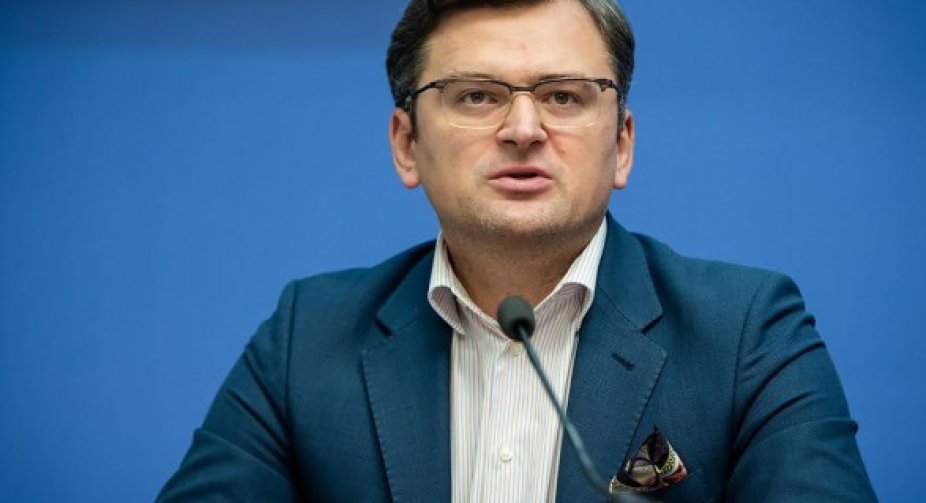

In order to make the security system of Europe more sustainable, Ukraine offers its vision. The main elements of the European future was told by Ukrainian Foreign Minister Dmytro Kuleba in his speech during the discussion "Ukraine-France" at the French Institute of International Relations, writes UNN.
"The future of European security will be based on strengthening the security architecture that has ensured the peace and prosperity of Europe for the previous thirty years. In order to make this security system more sustainable and update the security firmware of our continent, Ukraine offers its strategic vision," Dmytro Kuleba said.
According to Kuleba, its first element is to strengthen established blocs and organizations, such as the EU and NATO, and to strengthen them with smaller alliances.
"These alliances include both members of these organizations and those who are not yet - or are already - part of them. Thanks to these alliances, Europe is becoming bigger than itself, and it is doing so in a flexible format. Additional small alliances can be an extension and reinforcement of the EU and NATO, not a counterweight. At a time when established alliances have difficulty reacting quickly and effectively because of trivial antagonisms between influential individual members, additional compact alliances can act quickly and solve problems," the minister said.
He reminded that Ukraine already has three such compact alliances: Lublin Triangle with Lithuania and Poland, this associated trio with Georgia and Moldova, "quadriga" with Turkey.
Europe, according to him, also has a number of such alliances. These include the Weimar Triangle, the Central European Five, the Slavkov format and a number of others.
"The development of a European network of small alliances will contribute to the flexibility of the entire security architecture rather than to its fragmentation. Decentralization will preserve stability in times of antagonism in international relations," said the diplomat.
"The second element. Europe will have to have the sanctions stun gun in its hands for some time. And also the courage to use it against those who encroach on the foundations of the security order," he continued.
As the minister notes, the EU has now developed such a package of sanctions against Russia, and, in his view, it will remain ready even when the current security crisis is resolved.
"The third element of a great and peaceful future for Europe is readiness for new and greater ambitions. Europe needs healthy ambitions, part of which will be Ukraine's membership in the EU and NATO. Why do I say these are ambitions? Because in order to become a global player, you need to play the big geopolitical game and build up your economic, political and dangerous muscles. It's like in soccer. Just sitting on the defensive is impossible to win, you have to counterattack. Of course, we are only talking about diplomatic counterattacks," says Kuleba.
Ukraine is exactly the potential that can bring it to a new level of influence on the global stage, he believes.
"We invite you to look into the future with us. Then we will have a clearer understanding of what to do to overcome the accumulated crises," the Ukrainian diplomat added.
Recall that President Volodymyr Zelensky in early February said from the rostrum of the Verkhovna Rada that Ukraine is creating a new format of political cooperation in Europe - with Poland and the UK.