

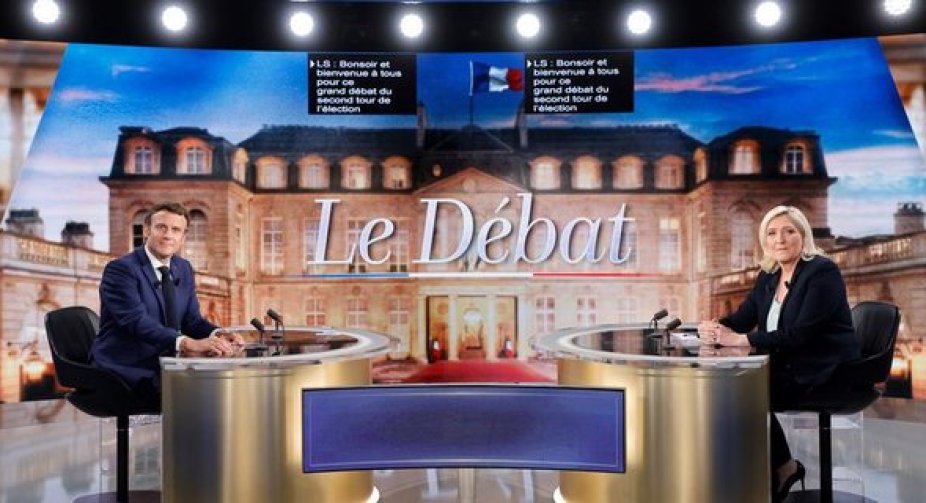

French President Emmanuel Macron and Marine Le Pen, leader of the right-wing populist Rassemblement Nationale party, held their first and last televised debate four days before the runoff election. One of the main topics of contention between the two politicians was relations with Russia and its attack on Ukraine.
The current debate is considered crucial because of the large number of voters who are still undecided. Although Macron is quite confidently leading in the polls, ahead of Le Pen by more than 10 percentage points, the fate of the presidency is far from certain, as more than 10 percent of French voters have not yet decided for whom to vote, according to the BBC News Russian Service.
Russia's war against Ukraine was the most important topic of Macron's and Le Pen's debates. Both politicians have a long history of relations with the Kremlin.
Shortly before the Russian invasion, Macron was one of the few Western politicians to visit Moscow.
After February 24, when Russian troops entered Ukraine, Macron sharply condemned Russia's actions and supported harsh Western responses, including arms to Kiev and economic sanctions.
At the same time, he continued to have hours-long telephone conversations with President Vladimir Putin. During them, according to French sources, the Russian leader told him at length about his vision of the history of Russia and Ukraine.
Le Pen has long been considered one of Putin's main European allies. Before the 2017 election, she said she did not believe Russia's annexation of Crimea was illegal, arguing that "there was a referendum, the people of Crimea wanted to join Russia."
During the current debate, Macron criticized Le Pen for such a stance - and recalled a €9 million loan her party received in 2014 from the First Czech-Russian Bank, which Macron said is close to the Russian authorities. "You depend on the Russian authorities and you depend on Putin," Macron told her. "When you talk to Russia, you talk to your banker," he added. "This dependence can explain many of your actions," Macron asserted.
The French president also recalled Le Pen's remarks about Crimea and asked on what grounds she considered it part of Russia. "Under international law, we do not often recognize territories that have been annexed by force," Macron said.
In response, Le Pen said she considers herself a "completely and in every way a free woman," and said her loan was widely known. She explained her decision to turn to the First Czech-Russian Bank as follows: "It happened because no French bank wanted to give me a loan.
Le Pen also said that she was forced to take out a loan just like millions of French people trying to survive in difficult economic conditions. Macron countered that the French, unlike her, do not turn to Russia for money.
At the same time, the leader of the Rassemblement National condemned Russia's actions against Ukraine. "The aggression victimized by Ukraine is unacceptable," Le Pen said, and she advocated helping Kiev and for the West to accept Ukrainian refugees. At the same time, though, she warned that supplying Ukraine with weapons could drag France into hostilities.
Last week, Le Pen said that after the Ukrainian war, NATO and Russia could once again establish closer relations, which drew a lot of criticism from French society.
Much of the debate between Macron and Le Pen, which lasted 2 hours and 45 minutes, focused on the sharp rise in prices, including energy prices.
In recent years, Le Pen has abandoned her intention to withdraw France completely from the European Union; she now advocates EU reform. Macron responded that his opponent's idea of a "Europe of different nations" would mean the end of the EU. "You are trying to sell people a lie," the French president said.
Television debates are traditionally considered an important factor in French presidential elections. During the first round, Macron received 27.85 percent of the vote, while Le Pen received 23.15 percent of the vote. Polls now show that Macron's advantage has strengthened slightly, with various predictions suggesting that the incumbent could win with between 53% and 57% of the vote.
After Wednesday night's debate, an express poll conducted by Elabe for BFM TV showed that 59% of viewers found Macron's arguments more convincing; 39% were more convinced by Le Pen's statements.