


In South Korea, the death toll from flooding and landslides caused by abnormal downpours has reached 49 and may rise as more victims are discovered in the affected areas as further search operations continue.
Such data were made public on Monday morning at the Central Headquarters for Combating Natural Disasters, Yonhap reports.
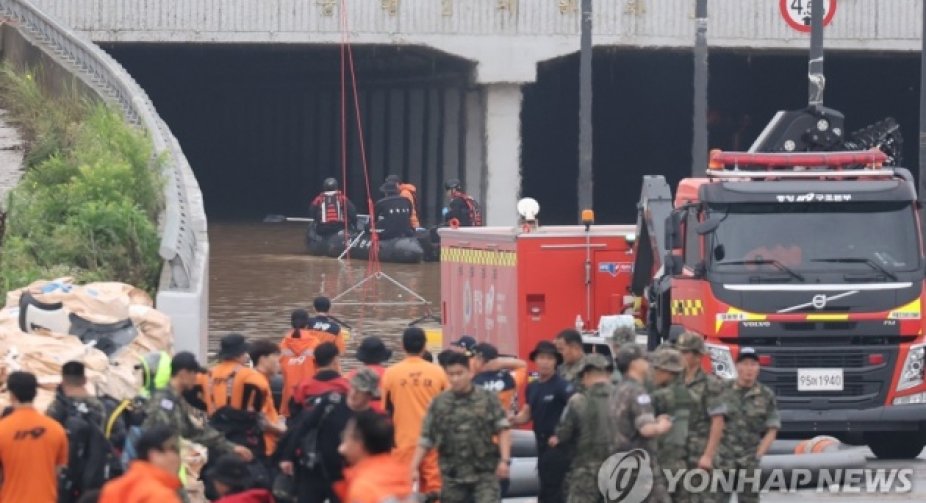
The most tragically known site remains the flooded tunnel in the city of Osong in the central region of the country, 112 kilometers south of Seoul, flooded on Saturday morning by a nearby river that overflowed its banks. As of Monday morning, rescuers found 16 waterlogged cars in it, one more than they had previously reported, from which they had already recovered the bodies of thirteen victims.
Rescuers continued to search for another person who is believed to be missing in the tunnel, but the search has been hampered by high levels of water mixed with mud in the underground passage, which reaches half a person's height.
The local police formed a special investigation unit to investigate the reasons that led to the tragedy, in particular, why traffic restrictions were not imposed for the underground tunnel, despite flood warnings on the nearby river.
According to the Central Headquarters, the number of people killed due to rains in the country has reached 40 people, nine more people are considered missing. About 10,570 people were evacuated across the country due to the rain.
The downpours damaged 628 public facilities and 317 private structures, including 139 flooded houses and 146 roads that collapsed or were inundated by high water.
A total of 28,607 households in the country were reported to be without power due to the heavy rains, but as of Monday, power had been restored to most of those households.
The Central Headquarters also said that since July 9, more than 500 millimeters of rain has fallen in the central and southern regions, and in some provinces this figure is 600 mm.
At the same time, meteorologists warned that heavy rains with strong winds are expected again in the coming days and up to 40 mm of rain per hour may fall.
South Korean President Yoon Seok-yeol on Monday, hours after returning from a European tour, held a Central Staff meeting and ordered the mobilization of all available resources and policy measures, including the designation of the most affected areas as special disaster zones, which would give them the right to receive government support.