

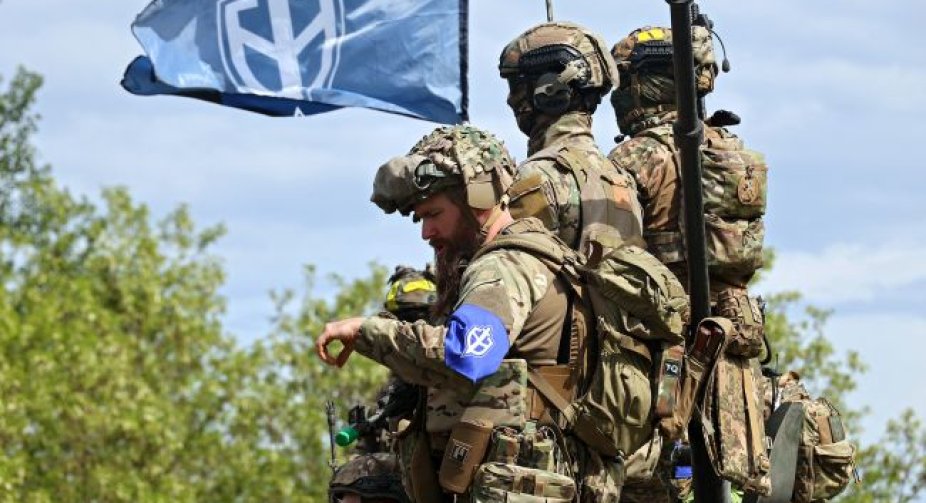

The raid by fighters of the "Russian Volunteer Corps" and the Legion "Liberty of Russia" in the Belgorod region continues for several days in a row. Guerrillas are trying to reach the border town of Shebekino and replenish the exchange fund with prisoners.
June raid
Another raid on the Belgorod region began on the night of June 1. The epicenter was the border town of Shebekino. It was reported that it was under constant fire all night and morning, as a result of shelling, according to the Russian authorities, 8 people were injured.
The administration building was also hit by the "Grad" salvo rocket systems.
In parallel with the shelling, the insurgents entered, fighting broke out at the Shebekino checkpoint. The fighters of the RDK immediately confirmed their presence in this direction and announced the implementation of the second phase of actions on the territory of the Russian Federation. They also confirmed their involvement in the "Gradam" attack. According to their information, the target was the Russian security forces who had gathered in the administration.
While the Ministry of Defense of Russia reported on the repulsed attempt to break through and the alleged destruction of "more than 30 terrorists", the RDK was already fighting in the suburbs of Shebekino - in the villages of Nova Tavolzhanka and Tytovka. And the "Freedom of Russia" legion published a video of the destruction of the Tulip self-propelled mortar, trucks with ammunition, and the "Grad" MLRS convoy.
Yesterday, advanced assault groups of the RDK and the Legion entered the suburbs of Shebekino. Videos of the destruction of Russian equipment in forest plantations appeared on the official channels of the rebels. The raid, which lasts several days, has already been recorded on the maps of the DeepState Map service. Previously, the "gray zone" covers almost 10 square kilometers, and Russian forces do not control Nova Tavolzhanka. As of July 5, the village is under the control of the RDK.
Today, the Legion "Freedom of Russia" reported the destruction of two tanks, an infantry fighting vehicle and an armored reconnaissance vehicle (BRDM). He also published a video calling on the Russian military to surrender.
It should be noted that several servicemen of the Russian Federation have already been captured. The authorities of the Belgorod region were offered to take them away, but no one came to pick up the prisoners.
Rebels take prisoners and want negotiations
The day before, the participants of the raid offered the governor of the Belgorod region, Vyacheslav Gladkov, to come to the negotiations and promised to release the two prisoners. The meeting could take place in the church in Nova Tavolzhanka.
"If you show up before 5:00 p.m.... we, as a gesture of goodwill, as it is customary to say in our homeland, will exchange these two prisoners simply for the opportunity to talk with you about the fate of Russia, the unnecessary bloody war that has been going on for a year and a half years, and now it continues on the territory of your Belgorod region," - the commander of the RDK, Denys Nikitin, addressed him.
Hladkov refused to go and stated that, in his opinion, the prisoners had allegedly already been killed. At the same time, he offered the fighters a meeting at the Shebekino checkpoint. In the end, the negotiations did not take place, and the RDK published a new video in which it showed that all the prisoners were alive and that they had increased.
Gladkov's action was criticized by the leader of the "Wagner" PMC Yevgeny Prigozhin. He hinted that the Belgorod governor had a "problem with eggs" because he did not dare to take prisoners who were "ready to be given for nothing."
The episode ended with the RDK deciding to transfer them to the exchange fund of Ukraine. And today there was a video of how Russian soldiers were taken prisoner.
In addition, it became known that representatives of the "Polish Volunteer Corps" are participating in the partisan operation. As explained in the RDK, the Poles operate exclusively on the territory of Ukraine and help with the convoy of prisoners, military and medical logistics.
Stanislav Zharin, the press secretary of the Minister-coordinator of Poland's special services, said that the members of the PDK are in no way connected to the Polish authorities and have nothing to do with the Polish Armed Forces or any institutions.
One more point - it turned out that RDK allegedly uses Belgian SCAR rifles. As Reuters writes, Prime Minister Oleksandr de Croo will seek clarification on whether small arms transferred to Ukraine were used in battles on Russian territory.
Panic reaction to the raid
One of the first decisions of the Russian side was the announcement of the evacuation of up to 1,000 children from the border areas. Russian President Vladimir Putin said that he regularly receives information about the situation in the Belgorod region and is "actively engaged" in the resettlement of people.
On the outskirts of Novaya Tavolzhanka, Russian security forces hit a civilian car. As a result, two people died. As the partisans noted, the enemy uses his favorite tactics and covers any points where he detects movement with artillery. Most likely, the car with civilians was mistaken for a car with a sabotage group.
To combat them, a special forces unit from the 322nd center of the "Senezh" SZG was urgently transferred to the border areas. In addition, traffic was prohibited on the roads around Shebekino. However, all things considered, these measures are not enough.
The American Institute for the Study of War (ISW) believes that the reaction of the Russian authorities to the RDK raids in the Belgorod region indicates anxiety in the information space and society.
Moreover, analysts believe that the Kremlin does not understand how to respond to the situation at all, and this provokes chaos, panic, increased unrest and criticism of it.
"The response has largely focused on informational impact, and there is no indication that the Russian leadership has established a broader policy to prevent further limited raids into Russia's border regions," the final ISW report said.
According to Gladkov, about 4,000 residents of the border area were evacuated to temporary accommodation points. But, according to representatives of the RDK, there is no organized evacuation, and people have to leave on their own.
At the same time, dissatisfaction with the military leadership of the Russian Federation is growing. The same Prigozhin continues to use the situation to criticize Defense Minister Serhiy Shoigu, Chief of the General Staff Valery Gerasimov, and Chief of Staff of the Ground Forces Oleksandr Lapin, who is personally managing the ousting of the partisans from the Belgorod region.
The so-called "militants" criticize the local authorities for their inability to inform the public about the events. And the war criminal Ihor Girkin believes that the Kremlin is unable to do anything about this situation, without resorting to diverting resources from the territory of Ukraine.
British intelligence is sure that the raids put Moscow in front of a sharp dilemma - to strengthen the defense in the border regions of the Russian Federation or to strengthen the positions in the occupied parts of Ukraine.
What they say in Ukraine
Ukraine denies the participation of representatives of its Defense Forces in raids in the Belgorod region. The official position is that the hostilities are an internal conflict of the Russians.
As the Center for Strategic Communications explains, the operations are carried out by the Russian liberation movement, which aims to overthrow the Putin regime. Moreover, they are conducted by the citizens of the Russian Federation.
"Ukraine defends its land and does not conduct hostilities on the territory of Russia," StratCom claims.
The situation in Shebekino is also being commented on in the President's Office. Mykhailo Podolyak, adviser to the OP chairman, believes that these battles lay the foundation for larger-scale military operations. He also called Shebekino the "gate of war" that carries it to the territory of all of Russia.
Podoliak suggests considering these events as the end of the era of "Putin's stability". In addition, he drew attention to the total informational disregard of Shebekini in the federal mass media.
"After all, there is no such thing as "what was not shown on TV" - right?", he added.
Andriy Yusov, a representative of military intelligence, says that the inability to stop the actions of the partisans is explained by throwing everything that can move into the occupation of Ukraine. In the future, this could lead to a rebellion or a larger military confrontation.
What happened in May
The previous raid in the Belgorod region took place on May 22-23. Then the Legion "Freedom of Russia" and the "Russian Volunteer Corps" took control of the villages of Kozinka and Hora-Podil, and also launched an assault on the border settlement of Graivoron.
A counter-terrorist operation was announced in the area. According to the Russian side, the security forces allegedly eliminated most of the saboteurs. Partisans recognized the loss of 2 people as dead and 10 wounded.
During that raid, the RDK and the Legion went several tens of kilometers deep into Russia, eliminated several Russian security forces, destroyed up to 10 units of armored vehicles and captured trophies.
The main intelligence department of the Ministry of Defense explained the actions of the volunteers as "the creation of a security zone" to protect the Ukrainian border. From the territory of the Belgorod region, attacks are regularly carried out on Ukraine.