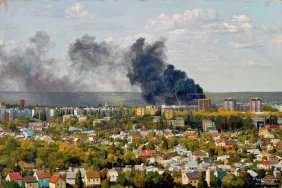


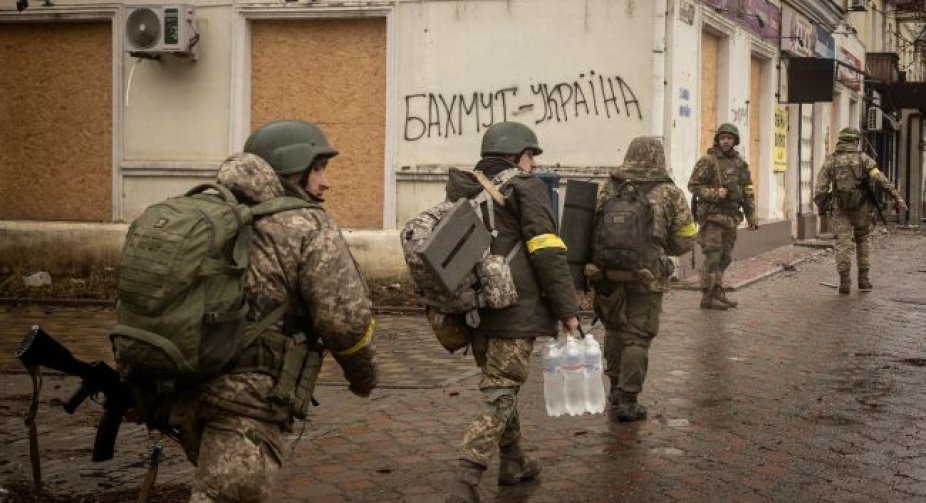

The Russians have increased artillery fire on Bakhmut, but the Armed Forces continue to hold positions in the city.
This was reported by the Institute for the Study of War (ISW).
The situation in Kharkiv and Luhansk regions
On May 7, Russian troops continued limited offensive operations northeast of Kupyansk and south of Kreminnaya. The General Staff of Ukraine reported that Russian troops conducted unsuccessful offensive actions near Synkivka, Kharkiv region (8 km northeast of Kupyansk); Belogorivky, Luhansk region (12 km south of Kreminnaya); and Spirny, Donetsk region (25 km south of Kreminnaya).
The Russian Ministry of Defense (MoD) said that Russian forces defeated four Ukrainian sabotage and reconnaissance groups near Kislivka (22 km southeast of Kupyansk) and Sinkivka, Kharkiv region, and Novoselivskyi, Luhansk region (14 km northwest of Svatovo).
Battles in Donbas
As of May 7, Russian troops achieved certain territorial gains in Bakhmut. Geolocation footage shows that Wagner Group forces advanced further west in Bakhmut and near Sacco and Vanzetti (15 km north of Bakhmut).
Russia's Ministry of Defense (Ministry of Defense) said Wagner forces had captured two neighborhoods in northern and western Bakhmut. A Russian military blogger claimed that Wagner Group forces made little progress in northern Bakhmut and continued to attack Ukrainian positions in western and southern Bakhmut.
The General Staff of Ukraine reported that Russian troops continued to attack Bakhmut, and Russian forces launched unsuccessful ground attacks near Bohdanivka (6 km northwest of Bakhmut), Khromovoy (immediately west of Bakhmut), Ivanovskyi (6 km west of Bakhmut), Chasovoy Yar (12 km to the west). Bakhmut), Stupochki (12 km southwest of Bakhmut), Predtechyny (14 km southwest of Bakhmut) and New York (30 km southwest of Bakhmut).
Woenkor, linked to Wagner, claimed that the militants' artillery increased the rate of fire in the Bakhmut area after the delivery of artillery ammunition on May 7 from the Russian Ministry of Defense. On May 7, Colonel Serhiy Cherevaty, the spokesman of the Eastern Group of Ukrainian Forces, said that it was not Chechen units, but the "Wagner" PMK that continued to attack Bakhmut, and noted that Russian artillery did not reduce fire in the city, despite claims of "shell starvation" in the area.
The commander of the Eastern Group of the Armed Forces of Ukraine, Colonel-General Oleksandr Syrskyi, said on May 7 that Russian forces had increased shelling in the Bakhmut area and that Russian forces still hoped to capture the city by May 9 (Victory Day of the Russian Federation).
Russian troops carried out limited ground attacks on the Avdiivka-Donetsk line on May 7. The General Staff of Ukraine reported that Russian troops launched unsuccessful ground attacks near Avdiyivka, Pervomaiskyi (11 km southwest of Avdiivka) and Maryinka (27 km southwest of Avdiivka).
A Russian military blogger claimed that Russian forces had failed to advance on the southern approaches to Avdiivka and Maryinka, and that Russian forces had increased the rate of artillery fire along the Avdiivka-Donetsk front line.
Russian forces did not conduct any confirmed or reported ground attacks in the western part of Donetsk Oblast on 7 May. The Russian Ministry of Defense claimed that Russian forces repelled Ukrainian intelligence in a combat operation near Velika Novosilka in the Donetsk region (32 km northwest of Vugledar) and a sabotage and reconnaissance group near Levadny in the Zaporizhzhya region (23 km northeast of Gulyaipol).
"Southern Axis"
The Russian Ministry of Defense (MoD) has acknowledged that Ukrainian troops maintain a presence on the islands in the Dnipro River Delta as of May 7. The Russian Ministry of Defense announced on May 7 that Russian troops had struck the Ukrainian command center on Velikiy Island (23 km southwest of Kherson). City).
On May 7, Russian troops continued regular shelling west of Gulyaipol, as well as in the Dnipropetrovsk, Kherson, and Mykolaiv regions. The Southern Operational Command of the Armed Forces of Ukraine reported that Russian troops fired five Kh-22 missiles at Mykolayiv Oblast and one at Kherson Oblast. The Southern Operational Command of the Ukrainian Armed Forces also reported that Russian troops struck Kherson, probably with two Onyx coastal defense missiles.
On May 7, Ukrainian troops continued to fire at Russian material and technical facilities on the eastern (left) bank of the Kherson region. The Southern Operational Command of the Armed Forces of Ukraine reported that Ukrainian aviation units struck two concentrations of Russian personnel and equipment in the Kakhovsky and Skadovsky districts.
Russian sources claimed that Ukrainian troops launched up to 23 drones into Crimea on the night of May 6-7. Russia's Defense Ministry claimed that Russian air defenses destroyed 22 Ukrainian drones over the Black Sea, while the occupying governor of Sevastopol, Mykhailo Razvozhaev, claimed that Ukrainian forces launched at least 10 drones toward Crimea and Sevastopol.
A well-known Russian military blogger claimed that Ukrainian troops launched 22 Mugin-5 drones and a Tu-141 Strizh drone, and Russian air defense units of the 31st Air Defense Division of the Black Sea Fleet together with unknown electronic warfare units shot down all the drones near Sevastopol and Gvardiyske (19 km north of Simferopol).
The Defense Ministry's acknowledgment of the claimed attack by Ukrainian drones is a departure from its usual statements and may be part of a larger Russian information effort aimed at not undermining Ukrainian capabilities in the face of a potential Ukrainian counteroffensive.
We will remind that the enemy continues to concentrate the main efforts on the Lyman, Bakhmut, Avdiiv, and Marin directions. The fiercest battles continue for the cities of Bakhmut and Maryinka.