


The special services of the Russian Federation installed a surveillance system in European countries with the help of antennas at the embassies that served Russian diplomats expelled from these countries.
This is stated in the investigation of the Dossier Center.
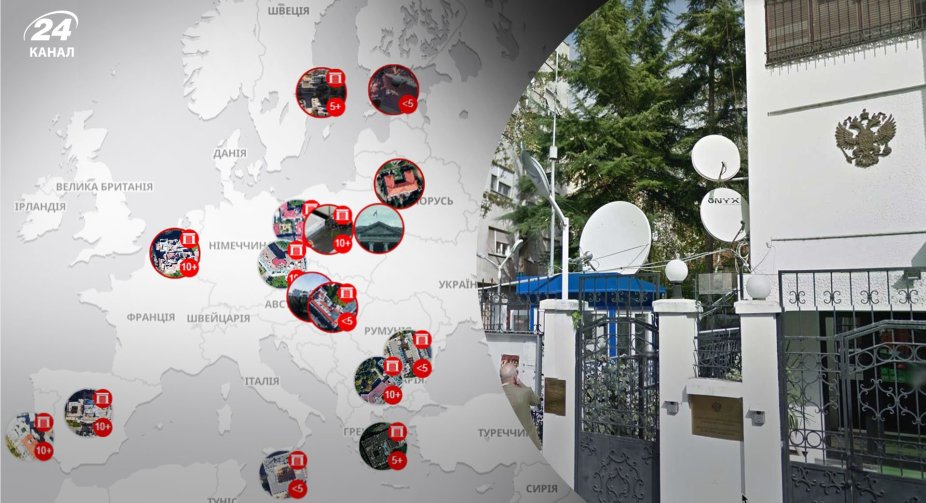
It is noted that the largest number of such antennas are installed on the premises of the Russian embassy in Brussels - 17. There are 10 or more of them on the roofs of Russian embassies in Madrid, Belgrade, Lisbon, Sofia and Nicosia. A total of 39 buildings of Russian embassies and consulates in Europe have at least 182 antennas.
Not all antennas are visible from the outside, so their real number is probably even greater, the investigators note.
As noted in the material, these antennas are nominally used for special communications. In fact, many of them are easily adapted for radio interception, for example, conversations on satellite phones. On the roofs of some embassies, in particular in Warsaw, devices that can listen to mobile communications have been spotted.
Employees of Russian embassies used such antennas for radio interception of satellite and listening of mobile communications. Many of the 400 expelled Russian diplomats, who were suspected of working for intelligence, were educated in the field of radio communication and computer technology. In Belgium alone, at least five of the exiled embassy employees were educated in the field of radio communication or computer technology and served in intelligence. Similar examples were found by investigators in Estonia and Sweden.
Embassies monitor not only the special services and politicians of other countries, but also the protests against the Kremlin's policies.
"When there are rallies nearby, the Russians can monitor phone traffic and collect data and identifiers, such as IMEI numbers of mobile phones," said a former Hungarian counterintelligence officer.
According to him, at least in Hungary, the Russians use this technology at full capacity. Cross-checking intercepts of electronic communications with embassy surveillance cameras, they monitor protests and gather information about local critics and Ukrainian groups.
According to the expert, it is almost impossible to deal with such eavesdropping. "Actually, you can't do anything, this is Russian territory. The maximum is to turn off or leave your phone at home if you see that the roof of the embassy looks like Baikonur," he advised.
One of the experts told the investigators that the radio-electronic intelligence equipment in Russian diplomatic missions falls under the FSB's area of responsibility. Moreover, the security forces maintain the equipment, even if a specific task is performed for the benefit of the SZR or the GRU. According to him, the technical staff of the FSB also supports purely intelligence operations.
Earlier it was reported that Norway declared 15 employees of the Russian Embassy in the country, who de facto engaged in espionage under diplomatic cover, to be undesirable persons.
According to the Norwegian special services, the exiled employees of the Russian Embassy tried to recruit new informants, conduct radio intelligence and buy advanced technologies.