

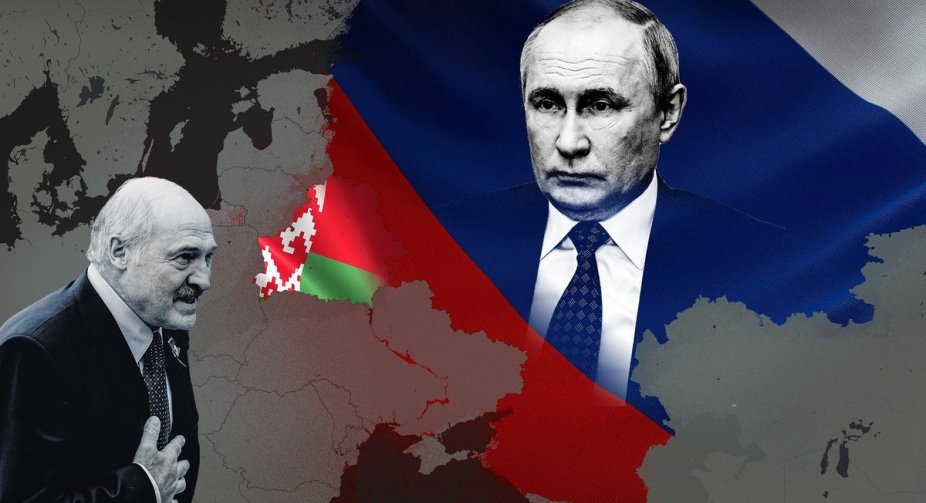

Russian authorities have drawn up a detailed plan of how the Kremlin plans to establish full control over neighboring Belarus over the next decade under the pretext of a merger between the two countries.
Journalists got access to an internal document called "Strategic goals of the Russian Federation in Belarus", which prescribes the full, phased accession of the Republic of Belarus to the Russian Federation by 2030.
Yahoo News, Süddeutsche Zeitung, WDR, NDR, Delfi Eesti, Expressen and Independent, the VSquare and Frontstory projects, the Dossier Center and the Belarusian Investigative Center participated in the investigation.
According to the 17-page document, dated fall 2021, the ultimate goal is to create a so-called Union State of Russia and Belarus no later than 2030.
The strategic document is divided into two parts. The first listed Russia's goals in the short-term (2022), medium-term (2025) and long-term (2030) perspectives. They are divided into three sectors: political, military and defense, humanitarian and trade and economic. The second part of the document defines the risks associated with the objectives.
Everything related to the merger of the two countries is considered, including the "harmonization" of Belarusian legislation with the legislation of the Russian Federation; "coordinated foreign and defense policy" and "trade and economic cooperation... based on the priority" of Russian interests; "Ensuring the predominant influence of the Russian Federation in the social-political, trade-economic, scientific-educational and cultural-informational spheres."
In fact, this means eliminating all remnants of Belarus' sovereignty and relegating the country to the status of a satellite of Moscow. This will make Belarusians dependent on the Kremlin's priorities, whether it is agriculture, industry, espionage or war. And this will pose a security threat to Belarus' European neighbors, three of which - Latvia, Lithuania and Poland - are members of NATO and the European Union.
The authorship of the strategic document, according to one Western official directly familiar with its development, belongs to the Office of the President of the Russian Federation for Border Cooperation, a division of President Putin's administration, which was created five years ago. The actual task of this innocuously named administration is to establish control over neighboring countries that Russia considers to be within its sphere of influence: Estonia, Latvia, Lithuania, Belarus, Ukraine, and Moldova.
For example, the document advocates "the formation of pro-Russian sentiments in political and military elites and the population" by 2022, and at the same time for "restricting the influence of "nationalist" and pro-Western forces in Belarus." It also foresees the completion of the constitutional reform in Belarus, which will be based on Russian priorities. Such reforms correspond to what has already happened in Belarus over the past year.
The document also describes how Russia's military presence in Belarus will be expanded, in particular through a joint command system and Russian weapons depots.
By 2025, the strategic document says, there should be "sustainable pro-Russian groups of influence in Belarusian politics, the army and business." He also advocates the expansion of the Russian military presence in Belarus and the introduction of a simplified procedure for issuing Russian passports to Belarusian citizens.
Another aspect of the slow takeover of the state by Russia is the introduction of a single monetary currency. Although the document does not directly say that it will be the Russian ruble, the implication is obvious given Russia's hegemonic role in these relations.
Much of Russia's strategy for Belarus focuses on what the document calls the "humanitarian sphere," a euphemism for the Russification and control of the country's civil society. One of the stated long-term goals is to double the number of Belarusian students studying at Russian universities, or to "open new centers of science and culture" in the Belarusian cities of Mogilev, Grodno and Vitebsk.
These centers will be a branch of "Rosspivorobnitstnik" - a Russian cultural and educational organization that formally works under the auspices of the Ministry of Foreign Affairs of Russia. However, Rosspivorobotnitsvo is a notorious information center for Russian intelligence and agents of influence, which greatly simplifies Moscow's ability to recruit Belarusians into its security agencies.
By 2030, according to the strategic document, Russia should have "control over the information space" and should create a "unified cultural space" and "a common approach to the interpretation of history" in Belarus.
One of the key results in this area is the predominance of the Russian language over Belarusian, which has already been largely achieved. The Russian language is enshrined in the Belarusian constitution as one of the two state languages.
According to the 2019 census, more than 60% of Belarusians said that Belarusian is their native language, but more than 70% of the country's residents said that they also speak Russian at home.
It will be recalled that on February 20, the self-proclaimed president of Belarus, Oleksandr Lukashenko, discussed with the Security Council a project on the "people's militia", in whose ranks they want to attract more than a hundred thousand Belarusians.
Earlier, Lukashenko said that the Belarusian army would join the Russian army in the war only in the event of a direct attack on Belarus.