

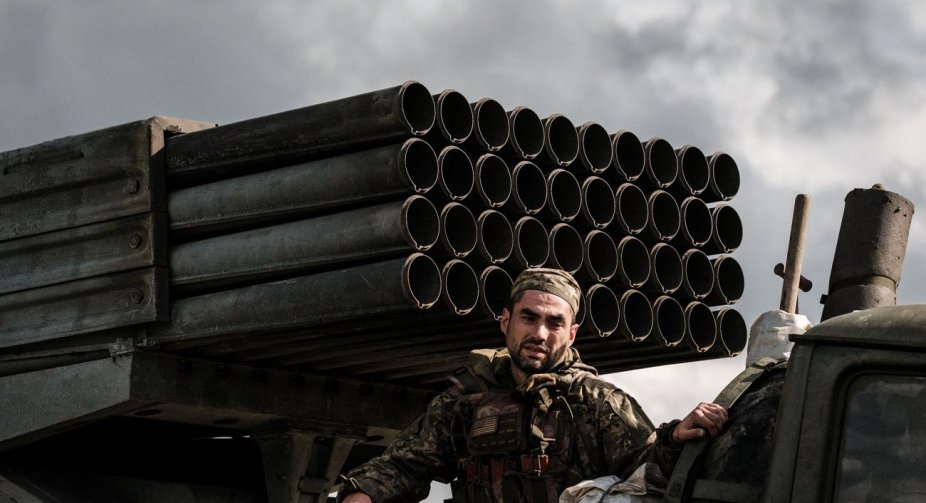

After Russia's invasion of Ukraine, a number of countries began to build up their arsenals by purchasing heavy weapons. The war in Ukraine sparked a new arms race.
French defense analyst and former government adviser Francois Gaisbourg noted that no country in the world has enough weapons stockpiles to conduct intensive hostilities. According to him, the world is on the threshold of a new era.
"It's a story about the end of the post-Cold War era, and it ended on February 24, 2022," Geisbourg said.
European and Asian countries began actively buying or producing weapons, and NATO this week made new decisions to strengthen defenses.
Poland
Immediately after the start of the full-scale war in Ukraine, neighboring Poland announced ambitious plans to significantly strengthen its army. The publication notes that the Polish plan has acquired an unprecedented scale and is probably far from feasible.
Warsaw has said it wants to buy 500 HIMARS systems. The authors of the materials emphasize that Ukraine weakened the occupying forces with the help of only 20 HIMARS multiple rocket launcher systems.
Also, Poland planned to acquire 700 new self-propelled artillery installations, which is six times more than in Germany's arsenal.
Germany
Last year, the German government decided to create a special defense fund in the amount of 100 billion euros, and next year it is ready to increase the defense budget by 10 billion euros.
The German company Rheinmetall has started investing hundreds of millions of euros in new factories and production lines. In particular, a new ammunition production facility will be opened in Hungary. Another German company, Diehl Defense, is increasing the production of IRIS-T anti-missile systems, which have proven themselves well in Ukraine.
France
Paris is also seeking to restructure its forces for high-intensity warfare. The French government has announced that during 2024-2030 the army will be strengthened and 400 billion euros have been invested in it.
French defense company Nexter is also ramping up production, with estimates that Russian forces in the Donbas produced as many rounds in a week in the summer as French forces produced during 13 years of training and deployment in Afghanistan, Lebanon, Mali and Iraq.
Hungary
Despite the fact that Hungarian Prime Minister Viktor Orbán refused to provide weapons to Ukraine, Budapest is also strengthening the army.
Hungary has ordered 45 new Leopard 2 tanks, 218 Lynx infantry fighting vehicles, an unspecified number of Airbus 225 and German PzH 2000 helicopters, as well as radars and US NASAMS systems to bolster its air defenses.
India
The country, which is far from Ukraine, also drew conclusions from the war. According to officials, the course of hostilities in Ukraine has highlighted India's weakness in long-range missiles, which it will need in a potential "contactless war" along its mountainous border with China.
The government therefore ordered the first batch of 120 new domestically produced short-range ballistic missiles known as Pralay, which are similar to Russia's Iskander. India has also ordered more MANPADS, including American Stingers.