

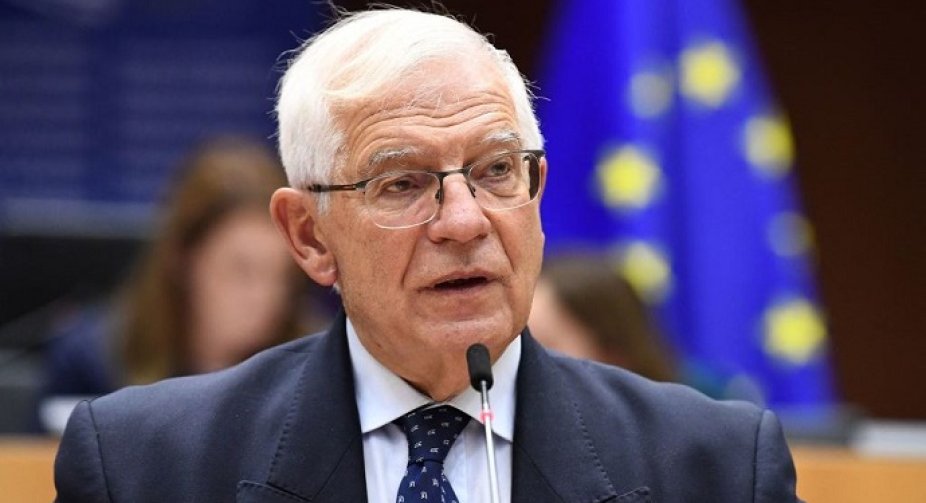

The Russian war against Ukraine became a "geopolitical earthquake", but the European Union did not experience Russian blackmail. This was stated by the EU High Representative for Foreign Affairs and Security Policy, Josep Borrell, in his blog, which was published by his press service.
"It has been a busy year. The Russian invasion of Ukraine became a geopolitical earthquake. This caused, in particular, a serious energy crisis in the EU. However, despite our dependence on Russian fossil fuel imports, we did not give in to Putin's blackmail. We managed to fill this gap and complete important reforms aimed at accelerating our energy transition. They will have a significant geopolitical impact," he emphasized.
Borrell noted that the war has already led to tens of thousands of deaths in Ukraine, and Russian troops have committed numerous war crimes.
"Having failed to conquer Ukraine, Vladimir Putin decided to destroy it and, in particular, its energy infrastructure, to force its citizens to live in cold and darkness this winter," Borrell added.
He recalled that the war also triggered a serious energy crisis in Europe due to Russia's use of energy as a weapon.
"Vladimir Putin obviously believed that the EU's strong dependence on the import of Russian fossil energy resources, in particular gas, would allow him to split the EU, depriving it of the opportunity to actively support Ukraine. That is why he began to limit the supply of Russian gas to the EU in 2021, despite valid long-term contracts between Russian suppliers and European consumers, then he intensified this policy of blackmail after February 24," said the head of European diplomacy.
He recalled that the EU managed to compensate for the lack of Russian gas mainly thanks to other sources of liquefied natural gas (LNG).
"We managed to replenish our reserves this winter and significantly reduce gas and electricity consumption. It is especially interesting to note how quickly Germany reacted. Russian gas imports were reduced from 55% of the total volume as of the beginning of 2022 to almost zero, and oil imports - from 40% to zero. This is a turning point in the relations between the EU and Russia, which until now largely depended on the energy issue," Borrell said.
In his opinion, in 2023 Russia's aggressive war against Ukraine, the energy and climate crisis and their economic and social consequences will remain the main problems for the EU and peace.
"The EU will continue to support Ukraine and resist Russia's weaponization of energy, accelerating the decarbonization of its economy. We also need to work with our partners to stabilize global energy markets and help the most vulnerable countries cope with the consequences of this new geopolitical situation," he said.