


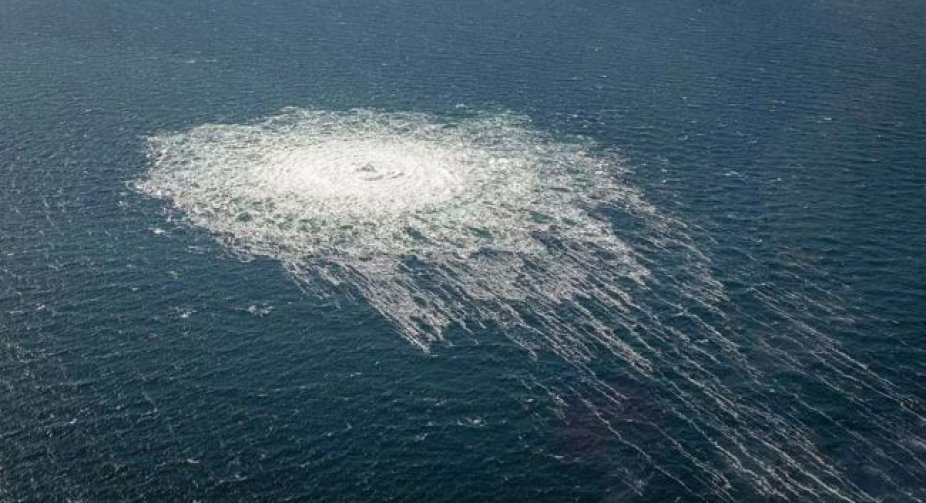

German investigators have determined that the series of explosions of the Nord Stream and Nord Stream 2 underwater gas pipelines from Russia to Europe were acts of sabotage. That is consistent with Sweden's earlier findings, according to officials familiar with the investigation.
This is reported by The Wall Street Journal.
German investigators have not been able to definitively link the alleged bombing to any one person, but German officials say they are working on the belief that Russia was behind the blasts.
The explosions caused leaks affecting three of four pipes that are part of the Nord Stream and Nord Stream 2 gas pipelines laid under the Baltic Sea to transport natural gas from Russia to Europe.
Moscow denies responsibility and says the explosions were a terrorist attack against Russian interests. A previous Swedish investigation concluded earlier this month that the explosions in late September were likely caused by sabotage, but did not name who was responsible. NATO said shortly after the attacks that the leaks were the result of sabotage, but did not provide evidence or name the culprits.
German officials say it is unlikely that the sabotage was carried out by a military submarine, citing the relatively shallow water depth and the usually close surveillance of submarines by NATO navies in the area. One theory for the attack is that explosive devices were dropped from the ship and then detonated remotely, German officials said.
The only pipeline that was not damaged by the explosions was one of the two threads of "Nordic Stream - 2". Germany refused to certify Nord Stream 2 after Russia's attack on Ukraine. President Vladimir Putin last week blamed the West for disrupting energy supplies and said it was "enough to turn on the tap" to restore gas to Germany through an intact pipeline known as Nord Stream 2.
Some German officials say that by leaving one thread intact after the attack, Russia is trying to increase pressure on German politicians to relent and open Nord Stream 2. A representative of the German government said that it does not plan to launch the Nord Stream 2 gas pipeline.
The Nord Stream and Nord Stream 2 pipelines pass through the waters of Germany, Sweden and Denmark. All three countries are investigating the incident. Swedish and Danish authorities have not yet released details of their investigations. The Federal Prosecutor's Office of Germany opened a criminal case on the fact of terrorist attacks, suspecting sabotage.
In Sweden, the country's counterintelligence service is investigating. In Denmark and Germany, the police and naval forces of these countries are involved in the investigation. For administrative reasons governing interagency intelligence sharing, Sweden is not conducting a joint investigation with its two neighbors, but officials say the three countries are working closely with each other as well as with NATO partners.
The depth of the sea in the area where the explosions occurred is about 70 meters. Due to depth and weather conditions, including undercurrents, German investigators were unable to use divers, officials said. Instead, they relied on naval underwater drones and surface ships, including minesweepers.
Drones on submarines and ships are equipped with sonar and video cameras that have scanned sections of pipes damaged by explosions. According to German officials, images from the blast sites show that the explosives had a power of about 500 kg in TNT equivalent.
The sounding included the study of underwater video, sonar data, as well as satellite images. Officials said they scrutinized the electronic messages and logbooks of vessels that were in the area at the time of the incident.