

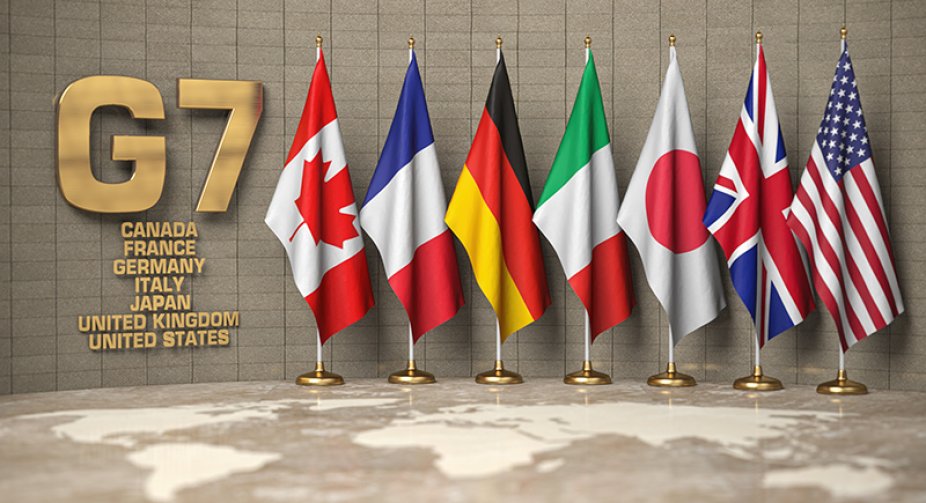

After the meeting in New York, the ministers of the Group of Seven issued a joint statement in which they condemned the latest escalating steps of the Russian Federation in the war against Ukraine.
The ministers emphasized that any state in the world in its foreign policy should refrain from threats to use force against other states or resort to other actions contrary to the principles of the UN, and condemned the latest decisions of the Kremlin.
"Any referendums in the conditions of the presence of the Russian military, intimidation and forced deportations cannot be free and fair. Any form of annexation of the territory of Ukraine will be a gross violation of its sovereignty in accordance with the UN Charter," they note, calling on the rest of the states to do the same position
The G7 also promises further point sanctions and continued economic and political pressure on the Russian Federation.
"They (the ministers) condemned Russia's deliberate escalating steps, including the partial mobilization of reservists and irresponsible nuclear rhetoric. Russia should immediately stop aggression, withdraw troops and weapons from Ukraine, and respect its sovereignty and territorial integrity," the text states. The Russian Federation is also called to stop "filtering" and forced deportation of Ukrainians from the occupied territories to the Russian Federation.
The preservation of the threatening situation at the occupied Zaporizhzhya NPP, the torture discovered in the liberated cities of the Kharkiv region, and the mass burial in Izyum were mentioned separately.
"Ministers and the high representative of the EU agreed to take care of the quick and thorough preservation of evidence on the spot, which is very important for bringing the guilty to justice. Ukraine can count on the support of the G7 in this," they said.
The signatories of the statement emphasized that Ukraine has every right to defend itself against Russian aggression and to regain control over the lost territory within internationally recognized borders. They also welcomed the success of the last counteroffensive of the Armed Forces.
The ministers confirmed the readiness of their countries to continue economic, financial, humanitarian, military and diplomatic support to Ukraine "for as long and on such a scale as it will be necessary to ensure Ukraine's path to freedom, peace, recovery and economic development".
The statement also talks about countering the global economic consequences of the Russian Federation's war against Ukraine. Among other things, the G7 agrees on the need to modernize the UN so that the organization can perform its functions more effectively.
The "energy" block mentions plans regarding the maximum price for Russian oil. "The G7 reaffirms its goal to create a broad coalition to make this measure as effective as possible, and calls on all countries that want to import Russian oil and oil products to commit to doing so only at or below the price set by the cap," - they write
In addition to blocks related to the war of the Russian Federation against Ukraine, two more concern the Pacific region. Among other things, the Group of Seven speaks out against "unilateral changes to the status quo" in the context of tensions around Taiwan, and expresses concern about China's policy towards the Uyghur minority.
We will remind, the group of seven includes Canada, France, Germany, Italy, Japan, Great Britain, the USA, and the chief diplomat of the EU also joins the statements.
Earlier, the head of EU diplomacy, Josep Borrell, confirmed that the European Union is starting to prepare the eighth package of sanctions against the Russian Federation for its aggressive war against Ukraine.