

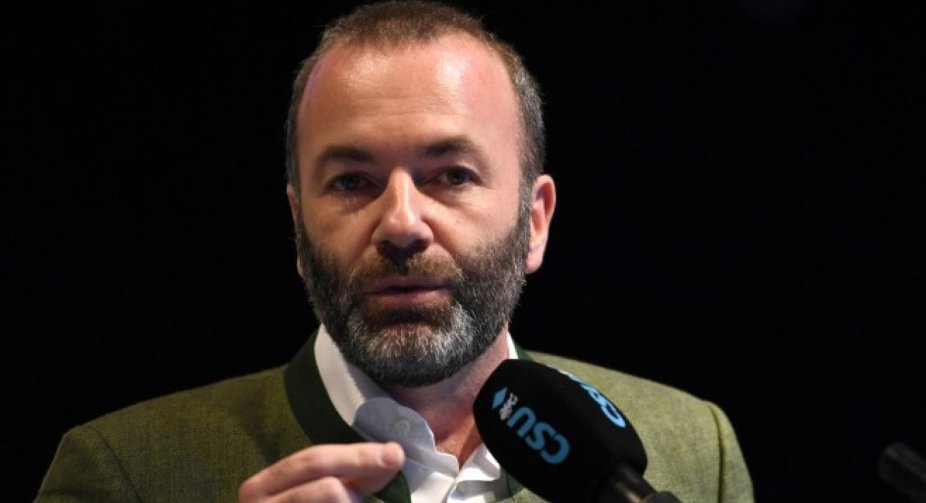

MEP Manfred Weber is one of the most influential politicians of the European Parliament. Last year, he headed the European People's Party (EPP), the main cross-party alliance in the European Union.
Weber is a German; he is a member of the Bavarian CSU, a long-time partner party in the bloc of parties until recently led by Angela Merkel. However, now he does not hold back in criticizing the mistakes of the then German government.
His statements may seem atypically harsh for a German deputy (even for an opposition one), but they are very necessary for Ukraine.
EuroPravda editor Serhiy Sydorenko interviewed Weber in Kyiv, where he arrived last week at the head of a delegation of the European People's Party.
Briefly, what Manfred Weber spoke about:
"I was among the few in the EU who did not doubt that the attack would happen.
I well remember the 2022 Munich Security Conference, when everyone told me: "no, he won't do it." But I was sure, otherwise Putin would not have invested so much effort in this military concentration on the border. The history of his actions proved that he is capable of this.
"We reacted late and still do not do much. I believe that the reason for this is the lack of leadership in Berlin and Paris. I believe that the supply of weapons is insufficient, as well as the sanctions pressure. It is good that we adopted ten packages of sanctions against the Russian Federation, and this is even more , than might be expected, given that sanctions require unanimity. But it is not enough to put the kind of economic pressure on Russia that it deserves."
"I believe that Europe, and first of all the European defense and industrial sector, should go into a military economy mode. We need to introduce an extraordinary military procurement mechanism to be faster in this.
We also need to provide Ukraine with weapons of long-range defeat, long-range artillery. This would mean serious logistical problems for Russia - so let's do it!
And finally, we need to stop paying attention to Russia's irrational behavior. We need to support Ukraine without fearing the Russian response."
"What Germany did was... it was naive! Attempts to find space for cooperation with Putin, to negotiate with him and to satisfy him - this approach was based on the hope that this would avoid further escalation. But the reality turned out to be different. And now we need a lesson from this.
And it should not be limited to Russia's war against Ukraine."
"We Europeans also need to get rid of our naivety about China."
He believes that the decision of the NATO summit in Bucharest - not to give Ukraine an action plan regarding membership - was a mistake.
"And if we have now invited Finland and Sweden to join NATO, then it is fundamentally clear to me that Ukraine has exactly the same right! Finland has about 1,400 kilometers of border with Russia, so I'm sorry, but now no one can say that Ukraine's entry" will bring NATO closer to Russia".
But it is obvious that Ukraine must survive the war in order to join NATO.
Manfred Weber noted that the key criterion for NATO expansion: the country's entry into the Alliance should strengthen security. And Ukraine, according to him, demonstrates this literally every day, restraining the terrible Russian war machine.
"You have proven your ability to be safe."
He also stated that Europeans are really waiting for Ukraine to join the European Union.
"Now our task is to fulfill this promise in view of the mistakes that the EU has made in the Western Balkans."
"There's one thing that's missing the most right now. That thing is historic leadership. That's what will really determine whether we can succeed."
He cited Germany's rejection of the Deutschmark and the introduction of a single currency, or the revival of the Bundeswehr to defend against the threat of communism, as an example of historical leadership.
"This is what I call historical leadership. Sometimes you have to go against public opinion, but do what is right in the historical moment. Now we are once again in a time when history is happening."
"That's why Scholz and Macron need to show leadership at a crucial moment in history."
And Manfred Weber absolutely agrees with the statement that one day Ukraine will win the war and believes that there are definitely people in Russia who want to live in freedom and democracy, and even Russian society can change.
"Of course, when it comes to the collapse of Russia, what happens after that is also important. But what we do must be based on what we believe. We must be guided by our values and our ideas, not our fears about "But what can happen, Russia is a nuclear power". There is no need to be afraid - and this is the main thing we should learn in Ukraine."