


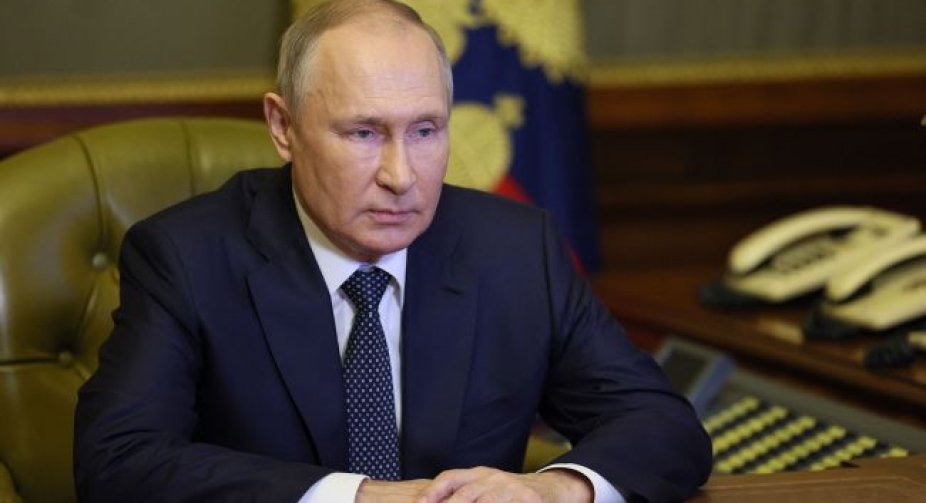

Vladimir Putin's rule in Russia remains strong, despite military setbacks in Ukraine, failed mobilization and political infighting. Well-informed sources say that could change quickly if he is defeated outright.
This is reported by Reuters.
As noted in the publication, most of the sources said that the Russian president found himself in one of the most difficult moments in his more than 20 years in power, as his troops were rejected in Ukraine.
The sources, including current and former Western diplomats and government officials, said there was no immediate threat from his inner circle, military or intelligence services.
"At the moment, Putin is holding his own," said Anthony Brenton, the former British ambassador to Russia.
He said he believed the Russian leader hoped to negotiate Ukraine, perhaps with the Americans, and hoped military success would return to him despite what the West says is a shortage of manpower, equipment and even missiles.
In power since 1999, Putin has weathered numerous internal crises and wars and repeatedly faced major street protests before effectively outlawing any real opposition.
However, the 70-year-old president's "special military operation" in Ukraine since February 24 has led to the most tense confrontation between East and West since the Cuban missile crisis of 1962 and triggered the harshest Western sanctions against Russia.
His army suffered humiliating retreats as well as massive losses, and hundreds of thousands of Russian men fled abroad to avoid being sent to the front. Putin is also rattling off nuclear weapons, which some interpret as a sign of desperation.
Some allies - from "Putin's foot soldier", as the pro-Kremlin leader of Chechnya Ramzan Kadyrov calls himself, to "Putin's cook" (the nickname of the one-time head of the mercenary group Yevgeny Prigozhin) - accuse the military leaders of bad warfare.
Brenton, who dealt with Putin during his second term, said there had been no public criticism of him from the political or business elite or any sign of action against him, but that may not last long.
"If they see that they continue to retreat in the spring, in March/April of next year, then my sense is that at that moment there will be serious problems for Putin - not at the level of the people, but at the level of the elite. You have a group of people who in - at the bottom of it, they are selfish and do not want to be part of a possible fiasco," he said.
"Working arguments"
Relatives' protests against the mobilization, Ukraine's decision not to deal with Putin, and US President Joe Biden's apparently unplanned and quickly retracted statement that Putin cannot be allowed to remain in power have fueled speculation about his future.
Putin's spokesman, Dmitry Peskov, said a Washington Post report this month that a member of Putin's inner circle had spoken out against him about the war was "absolutely untrue" but said there had been a frank political debate.
"There are working arguments: regarding the economy, regarding the operation," Peskov told reporters. "This is not a sign of some kind of split."
The Kremlin says Putin has the support of the vast majority of Russians, and he won a landslide re-election in 2018.
Russia's political system is notoriously opaque, although in the run-up to the invasion, Washington showed it could see through Moscow's plans.
A senior Western official, who is closely monitoring the situation and declined to be named because of the sensitivity of the subject, said there had been no serious betrayals so far.
According to the official, there were signs of arguments, complaints and slow decision-making, "but there are no signs that he has lost control."
A US official, who declined to be named for the same reason, said Washington and its allies consider Putin's position credible. "However, many of his recent actions, including mobilization, clearly show that Putin is falling behind."
With powerful intelligence services supporting a political system staffed by closely watched loyalists, it would be difficult and dangerous for anyone to oppose him.
Andrew Weiss, a Putin expert at the Carnegie Endowment, said that while "anything is possible" in Russia, public opinion is less important there than in the West, real opponents have fled or been imprisoned, and Putin has been surrounded by loyalists.
The Russian leader could be toppled by a palace coup, an elite uprising or a massive "storming of the Bastille," he said, noting that Iraqi leader Saddam Hussein ruled for more than a decade after his failed invasion of Kuwait in 1990.
Fear prevails
Tetiana Stanova, founder of the R.Politik research firm, said that Putin will be in trouble if he runs out of options to escalate the conflict.
In that case, the elite will try to persuade Putin to resign, she predicted, adding that there was no sign yet of the coups that toppled Soviet leader Nikita Khrushchev in 1964 or targeted Mikhail Gorbachev in August 1991.
"If he can fulfill his unspoken obligations to the elite and the population - stability, peace, pensions and salaries - then nothing will threaten him. But if the Russian army is pushed back to the old borders of Russia, if the Ukrainian army goes further on the offensive and if the budget will not last and there will be delays with pensions, the elite will gradually mobilize," he said.
While opinion polls in Russia show growing public anxiety, one French diplomatic source said they believed Putin, who dominates influential state media, would be able to retain power.
"Let's not forget that fear reigns," the source said. "I still think that the majority of Russians will support Putin, no matter what he decides."
A senior European official said Putin would have to lose the war demonstrably to be removed from office.
If and when that time comes, former British ambassador Brenton said, his successor is unlikely to be a friend of the West.
"The people who will make the decisions are tough guards. We will not get a nice liberal," he said.
Earlier, the former vice-prime minister of the Russian Federation, Alfred Koch, said that Western special services could take over Putin's removal by organizing an operation similar to the elimination of Osama bin Laden. This scenario will suit the Russian "top" completely.