


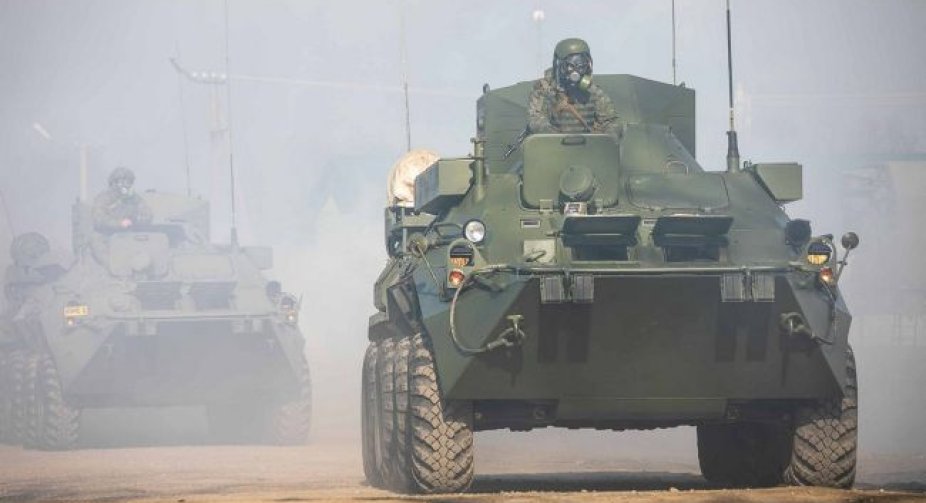

Russian troops are now actively pulling their forces to the south of Ukraine. It is likely that the enemy may be preparing for an attack on Kryvyi Rih, and it is also possible that they will try to move towards Zaporizhzhia and Mykolaiv.
Natalya Gumenyuk, head of the press center of the Defense Forces in the south of Ukraine, confirmed that now the Russians are really redeploying troops to Kryvyi Rih and it is possible that the Russian Federation can both really prepare for a counterattack and try to mislead the AFU and intimidate civilians.
At the same time, she stresses that all the enemy's actions are monitored, and therefore there is no reason to panic.
At the same time, UC Yug stated yesterday that the enemy has begun creating a strike force in the Kryvyi Rih direction and may be preparing a counteroffensive to reach the administrative border of the Kherson region.
However, experts suggest that the occupiers have broader "appetites", namely to go with a sweep through Kryvyi Rih in order to surround Zaporizhzhia.
In the event of such a scenario, the enemy troops from the Krivoy Rog area will break through to meet the grouping from the Vasilievka-Orekhovo-Gulyaypol area.
According to military expert Colonel Sergei Grabsky, the Russians will not now have the physical ability to restore the crossing of the Dnieper, and they need a very wide bridgehead to further advance on the right bank of Kherson towards Mykolaiv, Odesa and on to Moldova, which is also part of their strategic objectives.
"Such a wide bridgehead can only be provided by the Zaporizhia direction," Hrabsky suggested, and noted that Zaporizhia is a large and very fortified city, which means it would be very difficult to take it by storm.
In the opinion of Oleg Zhdanov, the military expert, from the Kryvyi Rih direction the enemy can move towards the Mykolaiv region - in this case its main goal will probably be Voznesensk in order to take Mykolaiv in the operational environment and further move towards Transnistria.
According to the expert's assessment, the occupants can develop the offensive in other parts of the front as well - in the Donetsk and Kharkiv directions.
"Judging by the way they are gathering troops, of course, the South Bug direction will be the main one. There they have collected the largest number of troops, concentrated the most combat-ready units. All the Russian airborne troops that are on the territory of Ukraine are assembled there. And these are purely offensive forces," Zhdanov suggests.
Another theory is that the aggressor will go to the offensive of Mykolaiv directly from the region of Kherson and then may try to bypass it from the north to force the Southern Bug and move towards Odesa, says Vladislav Seleznev, the former head of the press service of the General Staff, colonel of the AFU.
Experts do not rule out that the Russian Federation may try to attack simultaneously in two directions - toward Mykolaiv and toward Kryvyi Rih.
"If the Russians are planning a simultaneous offensive on Mykolaiv and Kryviy Rih - then the conditional slap will be loud, but the force of the blow is none. I think that the Russians will single out Krivoy Rog as the main direction, because that is where they transfer the main amount of forces and means. And Mykolaiv may be a secondary direction," Seleznev suggested.
However, another scenario is likely: the Kherson-Mykolaiv direction will be considered by the occupants as the main direction, but if there are more successes in the Krivoy Rog area, the enemy can put blocking rearguard in the Mykolaiv direction and transfer most of the troops to the north, concluded the expert Grabsky.
As a reminder, it also became known that about 30 battalion tactical groups (BTGr) have already been concentrated in the Kherson and Zaporizhzhia regions, which amounts to about 22,000 men, which is most likely not the final figure.