


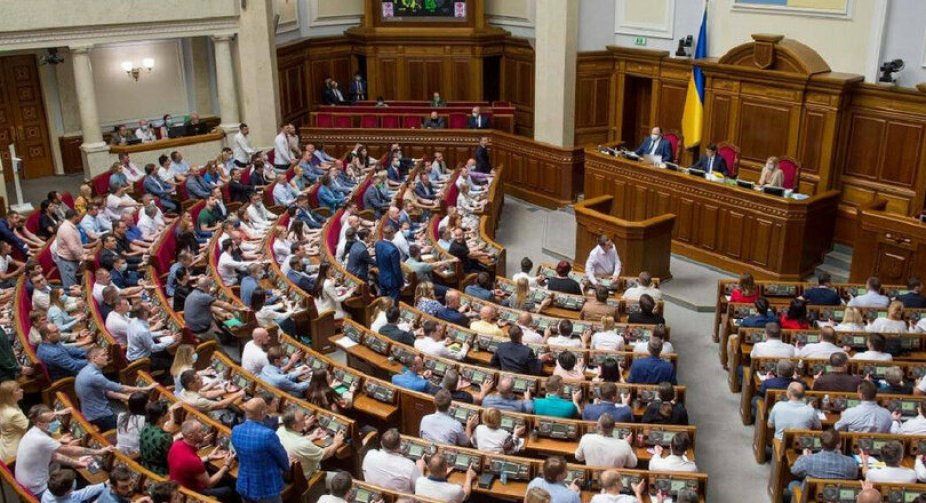

We recall the political events in Ukraine in 2021, which influenced our future. What of the predictions came true, what determined the next trends, and what processes were unpredictable, we look at the political results of the year.
January: "Servants" ratings fall, tariffs rise, the U.S. imposes sanctions against Derkach and Dubinsky
The previous year 2020 (as well as the current one) ended on a negative note for the president of Ukraine - in three polls in a row (from the Razumkov Centre, the "Democratic Initiatives" Foundation and KMIS) Volodymyr Zelenskiy was called the disappointment of the year and the loser of the year. However, according to the voters' whimsical will he also became the politician of the year 2020...
At the start of 2021 Zelensky came out with a trust rating of 30.6%, trailing behind the Speaker of the Parliament Dmytro Razumkov (35%). A year ago it seemed that the ratings were a bought-and-paid-for thing and that the "patriotic U-turn" and the National Security and Defence Council would be able to fix everything. But in a matter of months the popularity returned to decline. The war was not over, the meaningless lockdown rules were outraged, and anti-tariff protests swept across the country. Already in March, speaking in parliament, the head of the Security Service of Ukraine Ivan Bakanov said that those who had ordered the "tariff maidans" were handlers from Russia.
The government's decision to lower the price of gas for the period of the quarantine appeared. The president tried to threaten to raise the tariffs by inspections of officials in the regions. This did little to change the tariff policy. In general, this composition of the Cabinet, in spite of (or thanks to) its grayness and impersonality, has remained in place until now, although Shmygal's cabinet has been buried for more than a year.
In mid-January, the U.S. State Department imposed sanctions on seven people with Ukrainian passports who are suspected of having ties to Russia. Among them were MPs Andrei Derkach and Oleksandr Dubinsky, a member of the "Servant of the People" faction. As early as February 1, Dubinsky was expelled from the "servants" faction at the personal insistence of the president, after which he became significantly less in the information field. Although he still remains an MP, elected in the majority district.
The conflict between Bankova and the Constitutional Court, which in 2020 tried to destroy the achievements of the authorities in the anti-corruption legislation, continued. The head of the CCU Oleksandr Tupitsky came to work after the winter break, which he spent in Dubai, but state security guards did not allow Tupitsky to work. The SBU informed him of the suspicion of perjury and witness bribery. But to resolve the conflict in their (and the state's) favor, Zelensky's team has not been able so far - the problem of semi-authority of the CCU went to 2022.
On January 26, the Verkhovna Rada passed a law on people's power through an all-Ukrainian referendum. The consequences of this decision are far-reaching and unpredictable, because referendums are a kind of weapon of mass destruction that can both destroy the country and unite it. And there is no telling what questions the authorities will want to ask the people's opinion on - say, the status of Donbass or something equally explosive. Yulia Tymoshenko was the first to try out the functionality of the law on grassroots democracy, proposing five questions for a referendum, particularly on the land market and legalization of gambling business. But she was rejected by the Central Election Commission.
February: sanctions against Kozak, Medvedchuk, and their TV channels
It all started with hints in anonymous telegraph channels that the presidential party was planning to change its ideology drastically once again. However, "green nationalism" has never developed into a systemic ideological platform for the ruling party. However, talk about the right-wing nature of the "servants", even if only in declarative form, had some basis in fact. On the evening of February 2, the National Security and Defence Council imposed sanctions on Viktor Medvedchuk, a close associate of Putin's cousin, and MP Taras Kozak and the television channels 112, NewsOne, and ZIK, which officially belong to him. They were banned from working for the next five years. It is still unknown how this story will end: the trials continue to this day. However, it is a fact that the ground has been broken from under the feet of the TV station. Meanwhile, at the same time as the pro-Russian mouthpieces were shut down, militants in occupied Donbas shelled the Ukrainian armed forces' positions with the Grad-P rocket system for the first time in a year and a half.
Two weeks after Medvedchuk's "pool" channels were shut down, the SBU announced that pro-Russian blogger Anatoly Shariy was under suspicion, specifically under the article "high treason. On February 19, the National Security and Defence Council decided to impose sanctions on Viktor Medvedchuk, his wife Oksana Marchenko, Taras Kozak's civil wife Natalia Lavrenyuk, and others, and President Vladimir Zelensky enacted the decision by decree on February 20.
But the short-term effect was achieved, and the drop in the ratings was temporarily stopped. The popularity figures even returned to growth. But, as autumn has already shown, it is only temporary: if the beast of political populism is not fed regularly, it begins to devour its masters.
The dismissed head of the CCU Tupitsky was left without state protection. "Sergei Golovaty has temporarily become the "keeper of the seal of the court. Ignoring the recommendation of European partners not to rush to fill the vacancy in the CCU, the majority on February 19 appointed Viktor Kichun, a creature of the president, as a member of the Constitutional Court. But even that did not ensure the restart of the Court and its work in the way Bankova wanted.
Serhii Sternenko was convicted, and not for the most high-profile case among those in which he appears. On the day of the verdict, a rally in defense of Sternenko was held at Bankova. 17 people were detained.
March: NSDC turns into the highest rating "evening show" of the country
Waiting for the release of the Bellingcat investigation, the EU faction came out with a public demand to create in the Parliament an SSC to investigate the circumstances of the failure to detain the Wagner mercenaries, actually searching for a "mole" in the upper levels of power. In a predictable twist, the monocyclical majority allowed this demand to go unheeded, creating instead a commission, which they called "a commission of inquiry for all treason. The result of its activity was the statements of Maryana Bezugla, for which she was furiously trolled.
The authorities media lost the start of the coronavirus vaccination. After a long and nervous wait, when all civilized countries were already in full swing to vaccinate their citizens, no Chinese vaccine was brought to Ukraine.
On March 20, another rally in support of Sternenko was held, which ended with broken windows, pyrotechnics, and the walls and doors of Bankova Street painted on. The ruling party demanded an extraordinary meeting of the Verkhovna Rada, but the "servants" lost the battle, giving the opposition an excuse to state their demands for the agenda of such a meeting: to hear information about the government's fight against the coronavirus, the creation of the VSC on the "Vagnerians," and a resolution to end politically motivated repressions.
The SNBO remained the country's highest-rated "evening show" at this time. Danilov announced that the SBU had been instructed to check the circumstances under which the Kharkiv agreements had been signed and ratified. On March 19, sanctions were applied to Yanukovych, ex-officials, and law enforcement officers (25 people in total). Then the decision to check the legality of obtaining all permits for the use of subsoil resources since 1991. Sanctions against individual smugglers. Thus, the NSDC turned into a body for implementing quick political decisions.
On March 27, the president cancelled the decrees of Viktor Yanukovych appointing Tupitski and Oleksandr Kasminin as judges of the CCU, thus exceeding his authority, so the court refused to accept the newly appointed judges.
April: Scandalous elections in Precarpathia and the law on oligarchs
On March 28, by-elections of people's deputies were held in the 87th constituency in the Precarpathian region and the 50th constituency in the Donetsk region. The CEC named Vasyl Virastyuk, a strongman and the "Servant of the People" candidate, the winner in Nadvirna district, and Andrei Aksenov came first in constituency #50. The result of the campaign in both districts was an extremely low voter turnout. The electorate felt deceived after the 2019 elections and was apathetic.
However, the struggle in Ivano-Frankivsk region was very fierce. Virastyuk, supported by a troop of "servants," wrested a mandate from a representative of Igor Kolomoysky's "For the Future" party of influence, former MP and top manager of the Bukovel resort Alexander Shevchenko. If at first Bankova simply wanted to save face, in the process they acquired a taste for it: they came to a public showdown with the entourage of Kolomoisky - a man who not without reason considers himself the creator of the current government. The Ivano-Frankivsk Regional Council made a half-hearted attempt to create something like a front to the will of Kiev by passing an appeal to all possible instances to invalidate the election, but it did not help either.
In early April, Viktor Lyashko, the Chief Sanitary Inspector, now the Minister of Health, announced the government's plan to vaccinate 70% of the country's adult population against the coronavirus by the end of 2021. However, by mid-December about 40% of adult citizens in Ukraine had been fully vaccinated against COVID-19.
On April 13, the President of Ukraine submitted a bill to the Verkhovna Rada to abolish the scandalous OASC, but Vovk is still there. The other day a court blocked the election of the head of the Specialized Anti-Corruption Prosecutor's Office. The appointment of the head of the SAP, we would remind you, was promised to President Vladimir Zelensky.
And it was in the middle of April that almost the key trend for the next half-year and longer was set - the preparation of the law on oligarchs was heard from Bankova.
May: Nuland and Blinken visit, Bankova versus Klitschko, Zelensky versus oligarchs
Kiev awaited the visit of U.S. Secretary of State Anthony Blinken and U.S. Undersecretary of State for Political Affairs Victoria Nuland. A series of meetings with domestic government officials and politicians took place. Among the participants of such conversations were Petro Poroshenko and Vitaly Klitschko. Soon a wave of searches swept the capital's utility companies.
The Rada dismissed Health Minister Maxim Stepanov. Viktor Lyashko became the new minister.
Volodymyr Zelensky ordered an audit of lands and residences in Koncha-Zaspa and Puscha-Vodytsia, establishing a list of residents there and the grounds for their stay. Soon some of the state residents were evicted, but some of them returned after a few months.
An "anti-oligarchy" draft law was made public. The main point that angered many people was that the president would decide who was an oligarch.
The authorities passed a law on affordable housing. As we predicted, it did not bring any changes to the affordability of apartments. A special state institution hastily created by the Ministry of Finance at the end of 2020, the Ukrainian Financial Housing Company (UkrFinHousing), has not yet helped a single family without housing. And the state bonds issued in October for 20 billion hryvnias (this is the amount of debt plus interest that the next generations will pay back for housing, which will be sold, say, next year) still have not been aimed at cheap mortgages or housing leases.
June: "homeless" MPs, paralyzed CCU, new protests, dual citizenship
On June 10, six judges blocked the work of the CCU Grand Chamber, demanding the presence at the sessions of Alexander Tupitsky and Judge Alexander Kasminin, who were fired from their posts by the president.
This is the second time since the beginning of the year that the "servants" have spoken about the introduction of dual citizenship in Ukraine. In January, the three deputies of the mono-majority - Oleg Dunda, Oleksandr Alixiychuk and Dmytro Mikysha - registered a corresponding bill, which is still unmoved in the Rada. And in June Maria Mezentseva from the same faction "Servant of People" came out with a similar initiative. There is no result in this case either. Such initiatives cause reproaches of unconstitutionality. We will see whether the bill on this subject, which was submitted by the President at the end of the year, will be considered by the Rada in 2022.
The "bow" at the end of the first half of the year were the protests near the walls of the President's Office, with which the "Resistance to Capitulation Movement", "Democratic Axe" and other organizations came. Zelensky himself provided the news, saying in an interview with "1+1" that he told Lukashenko himself about the details of the special operation on the "Wagnerites.
July: Avakov retired, Chaus in panties, Bragar's "servant" stopped by cops
On July 1, the Rada passed the law on indigenous peoples, introduced by President Zelensky. It terribly angered the Kremlin, Putin found in it the implementation of "the theory and practice of Nazi Germany." The president of the aggressor state constantly mentions this law with frank irritation.
"Servant" Yevgeny Bragar got into a scandal with patrol officers. Metropolitan cops stopped his car because the MP allegedly had signs of drug intoxication. There was a big scandal, which ended with the fact that the policemen were found guilty - for not switching on the breast-vehicle cameras during the checking. Then, a Kiev majoritarian Alexander Yurchenko, who had been earlier expelled from the "Servants of the People" faction because of suspicions of corruption, allegedly caused a traffic accident in Lvov, but in the end he was not held responsible.
On July 12, there was a landmark resignation in the government: Interior Minister Arsen Avakov wrote a statement. He had served in that position for 7.5 years under two presidents. The Rada appointed Denis Monastyrsky, a member of the "Servants of the People" faction, as the next minister.
On July 30, Ukrainians were presented with the scandalous judge Nikolai Chaus, who had been kidnapped in Moldova - he was found in a village in the Vinnitsa region, reported that he had been kidnapped by unknown persons, and confirmed that he was a former judge of the Dneprovsky District Court of Kyiv. The police were called by the village headman, who reported that the ex-judge was allegedly "wearing only his underpants.
From there on, a real live action involving the SBU and the NABU was going on around him. At the moment, the judge is under investigation.
In July Golos split for good - some of its members did not participate in the party congress of July 29 and left the party. Before that, the "Golos" faction split - ten MPs announced the creation of a new association.
August: the government is at war with Razumkov and Klitschko
Talks intensified about the resignation of the capital's mayor Vitaly Klitschko from his position as head of the city state administration and his replacement with an official led from the presidential office, but it did not happen. At the same time, they began to predict the resignation of Chairman of the Verkhovna Razumkov, who went against the party line.
The authorities organized a lavish celebration of the 30th anniversary of Ukraine's independence. This time there were almost no scandals, and the celebrations on the Maidan and the military parade with a flyover by aircraft left positive impressions.
September: the assassination attempt on Shefir and the oligarch law
On September 22, near Kiev, unknown persons fired at the car in which presidential advisor Sergei Shefir was traveling. The driver was wounded, but Zelensky's associate himself escaped injury. The case of the assassination attempt is still being investigated without much success.
On September 23, the Rada voted on the so-called law on oligarchs, #5599. The result was secured by 229 members of the mono-majority and deputies from other associations and groups ("For the Future", "Dovira", 11 votes in favor from the "schismatic" part of "Golos"), who demonstrated their loyalty to the Bankova. It turned out that the votes had been collected with violations of the VR regulations. However, the authorities turned a blind eye - the law was signed by the president and enters into force in May 2022.
October: Razumkov's dismissal, the law on the NABU, sanctions with mistakes. There is a new mayor in Kharkov.
At the beginning of the month the entire faction of "servants", along with some officials gathered for another battle approval in Truskavets. The president was invited, Razumkov was not. And soon he was removed from his post, replaced by Stefanchuk.
Secretary of the Security Council Alexei Danilov made a resonant statement that the decision of the National Security Council on sanctions against thieves in law had been mistaken about 108 people. And this is not the first time sanctions have been wrongly imposed.
The Verkhovna Rada returned the law on the National Anti-Corruption Bureau to the framework of the Constitution. Now the head of the NABU is appointed by the Cabinet and not the president after an open tender. As a reminder, the current director of the bureau, Artem Sytnik, whose tenure comes to an end on 16 April 2022 and against whom law enforcers have many complaints, was appointed by President Petro Poroshenko after a competition. According to the Constitution, the head of state has no such right.
On the last day of October, a number of elections were held in Ukraine, from the election of people's deputies in the Kherson and Cherkasy regions to voting for the mayor of Kharkiv and deputies of a number of local councils. Igor Terekhov became mayor of Kharkiv. The elections in the Carolyn-Bugazh UTO in the Odessa region, where expensive resort land is a coveted resource for many, were scandalously disrupted.
November: anti-vaccination protests, "Vovina Thousand" and Zelensky's scandalous press conference
On November 3, a rally of anti-vaccinationists was held in the center of Kiev. Within weeks, one of the organizers, the Lviv-based "antivax" Ostap Stakhiv, was detained by the SBU on charges of attempting to overthrow the constitutional order in Ukraine. A court arrested him with the possibility of paying a bail of 1 million hryvnias. On December 1, this amount was collected by his supporters and Stakhiv left the detention center.
On November 4, instead of Andrei Taran, Alexei Reznikov became Minister of Defense. A "servant" Iryna Vereshchuk was appointed to the post of Minister of VOT vacated by him. Yulia Sviridenko from the Presidential Office was appointed first Deputy Prime Minister and Minister of Economy instead of Oleksiy Lyubchenko, who had worked in his position only since May 20. On the same day Oleg Uruskiy, Minister of Strategic Industries of Ukraine, was dismissed, Pavel Ryabikin took his place, and Minister of Ecology Roman Abramovskiy resigned, a full replacement for whom has not yet been found. Denis Shmygal's Cabinet is a record-breaker in the number of ministerial replacements, most of whom resigned without having to report to parliament. The society does not even try to explain why the new people in the government are more effective than their predecessors.
On November 16, President Zelensky promised that all those vaccinated with two doses would receive a thousand hryvnias, but not in cash, and that it could be spent on a limited set of goods.
On November 22, former Interior Minister of Ukraine Arsen Avakov published this photo on his Instagram with the caption "Yes, yes, this is exactly what you think. The photo shows Avakov with journalist Dmitry Gordon, pediatrician Yevgeny Komarovsky, TV host Savik Shuster, former Prime Minister Volodymyr Groisman and businessman and Shuster's business partner Pavel Yelizarov. Two days later Avakov gave an interview on Akhmetov's channel, which had a great resonance and stated that some politicians had united against Zelensky.
Former speaker Razumkov also became a frequent guest on Akhmetov's channel, and his inter-faction association "Reasonable Politics" included more than 20 "servants", two members of the Batkivshchyna faction and one unaffiliated MP, who was excluded from the mono-majority.
On November 26, Volodymyr Zelensky held his most scandalous press conference, at which he announced that a coup d'etat was being prepared, in which Akhmetov wanted to be dragged in, and he sassed journalists Butusov and Tkach. After the first statement, the value of shares in Ukrainian companies, primarily those owned by Rinat Akhmetov, collapsed.
December: Gogilashvili and Poroshenko's suspected treason
On December 1 the president delivered a message to people's deputies, promising to create the possibility of online elections and to submit to the Rada a law on dual citizenship, the relevant bill Volodymyr Zelensky has already introduced.
On December 11, Deputy Interior Minister Alexander Gogilashvili caused a scandal at one of the checkpoints in the Donetsk region. He attacked law enforcers for not recognizing him and demanding to see his documents, behaving boldly and claiming that he was the only one with such a fuck-up. He called the law enforcers cronies and promised them problems.
Soon the media reported that Gogilashvili might still have a passport as a Russian citizen and other interesting facts from Gogilashvili's biography surfaced. It turned out that Gogilashvili's wife Maria Levchenko, who works as an assistant to President Volodymyr Zelensky, is not registered as an OP employee; the chief of Ukrainian intelligence service Kirill Budanov lives with them in the house which Gogilashvili rents from the Strelkovsky spouse. In general, it was a total face-palm.
On December 13, Gogilashvili was dismissed from the position of the Deputy Minister of Internal Affairs of Ukraine, but the case of his Russian passport was not investigated. The former Deputy Minister himself claims that he does not have a Russian passport.
Already in the last days of the 2021 Parliament, David Arahamia spoke about the "secret plan" of Bankova, designed to help Volodymyr Zelensky and his party to retain power. To do this, the "servants" may try to change the Electoral Code next year and return majoritarian elections to parliament. There is already a corresponding draft law.
Under the Christmas tree was disrupted the competition to elect the head of the Specialized Anti-Corruption Prosecutor's Office and announced a suspicion of treason against Poroshenko. He did not pick up the summons and left on an extended tour abroad, from which he promises to return in mid-January. It is possible that on his return he will be arrested.
The next political year promises to be no less interesting.