

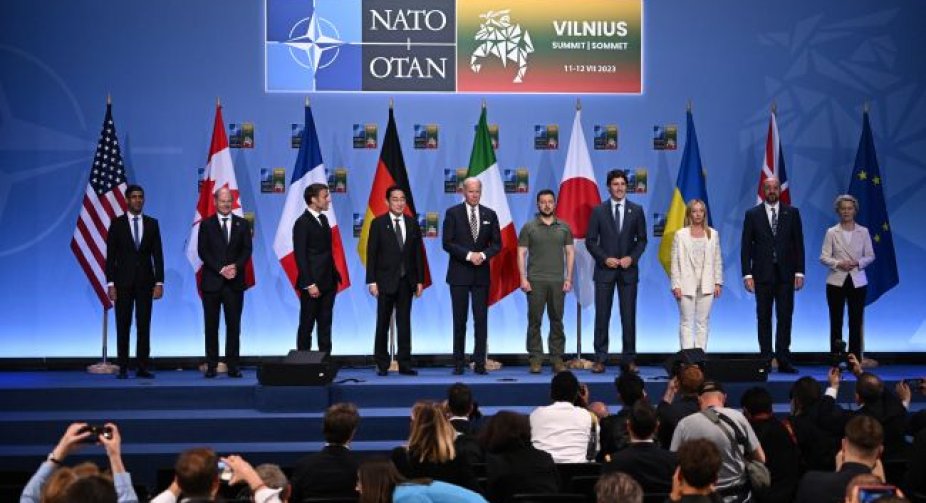

The NATO summit in Vilnius showed how far the full-scale invasion of the Russian Federation pushed Moscow away from the initial goals for which the aggression against Ukraine began.
This is reported by the ISW report.
Preventing the expansion of NATO and the distance of the Alliance's borders from Russia were among the stated goals of the Kremlin before the invasion of Ukraine. The Kremlin repeatedly reiterated this goal throughout the war.
The lack of general resonance in the Russian information space in connection with the events at the NATO summit, as well as Finland's accession to NATO and Turkey's agreement to send the protocol on joining the Alliance to Sweden, probably indicates that the Kremlin suffered and absorbed these defeats.
Many Russian sources report on the NATO summit in a dispassionate and muted manner, incomparable to the broader defeat that the summit actually represents for Russia's pre-war goals.
ISW Key Findings:
Ukraine concluded bilateral agreements in the field of security and defense during the second day of the NATO summit on July 12.
On July 12, Ukrainian forces continued counteroffensive operations in at least three areas of the front line and reportedly achieved success in some areas.
The Ministry of Defense of the Russian Federation reported that the "Wagner" PMC has almost completely handed over weapons and military equipment to the Ministry of Defense.
Russian and Ukrainian forces are reported to have conducted limited ground attacks along the Kupyansk-Svatov line.
Russian and Ukrainian forces continued to clash in the Kreminnaya area, where Russian forces reportedly made limited gains.
Ukrainian forces continued counterattacks in the Bakhmut area.
Russian sources claimed that Ukrainian forces carried out limited ground attacks in the west of Donetsk region.
The Armed Forces of Ukraine continued counteroffensive actions along the administrative border between Zaporizhzhia and Donetsk regions.